


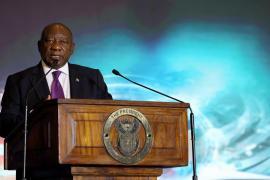
President Cyril Ramaphosa has called for renewed political commitment, stronger institutional support and sustainable financing to fast-track Africa’s infrastructure development.
Addressing the Presidential Infrastructure Champion Initiative (PICI) Heads of State and Government Meeting on Friday at the Union Buildings in Tshwane, the President said strategic infrastructure remains central to Africa’s transformation, trade integration and long-term economic growth.
“Africa stands at a pivotal moment in its development journey. Through the Presidential Infrastructure Champion Initiative, we are charting a course to accelerate the continent’s transformation by placing strategic infrastructure at the heart of our shared vision,” the President said in his closing remarks.
The meeting reviewed progress made under the PICI portfolio and reflected on joint actions required to maintain momentum, particularly ahead of the African Union Summit scheduled for mid-February.
President Ramaphosa emphasised that infrastructure development goes beyond physical construction, noting that its impact must be felt at community level.
“This initiative is not simply about building roads, bridges and energy corridors. It is about connecting our people, our economies and our aspirations.
“We need to ensure that these projects translate into tangible progress for every community, every region and every citizen,” he said.
In his opening remarks, the President highlighted infrastructure as a key catalyst for inclusive growth, enabling access to markets, essential services and economic opportunities across the continent.
“Infrastructure is a catalyst for economic growth and drives inclusive development. By prioritising infrastructure development, we are laying the groundwork for long-term economic resilience and continental integration through the African Continental Free Trade Area,” he said.
Citing a joint report by the OECD and the African Union Commission, President Ramaphosa noted that Africa could double its GDP by 2040 if infrastructure investment is scaled up, but warned that the funding gap remains significant.
“It is estimated that between $130 billion and $170 billion is required annually to close the infrastructure funding gap in Africa,” he said.
Governments account for 41% of the continent’s infrastructure spend, underscoring their role in mobilising investment alongside development partners and the private sector.
Despite fiscal constraints and geopolitical shifts, President Ramaphosa said flagship projects under the PICI have shown resilience, pointing to progress on major cross-border initiatives.
“The Trans-Sahara Highway, for example, is now more than 90% complete.
"The Algerian segment of the fibre optic link between Nigeria and Algeria is now operational,” the President said.
He also welcomed efforts to eliminate roaming charges in the East African Community and renewed political momentum around the Trans-Sahara Gas Pipeline and the Abidjan-Lagos Corridor, which has mobilised more than $15 billion in investment interest.
To sustain this progress, the President said the PICI Secretariat must evolve into a dedicated project facility capable of moving projects from concept to financial close.
“With sufficient financial capacity, we will be able to deploy high-level technical expertise, conduct rigorous feasibility studies and create investment-ready packages that meet international standards,” he said.
However, President Ramaphosa acknowledged that challenges such as financing constraints, weak coordination, limited secretariat capacity and security risks continue to slow progress.
“These are real and pressing obstacles but they are not insurmountable,” he said.
Looking ahead to the upcoming AU Summit, the President said the focus must be on securing a clear mandate to strengthen political support, institutional capacity and financing for the next generation of infrastructure projects.
“We seek a mandate that re-energises political support for the initiative, that strengthens its institutional base, and that secures the sustainable financing and partnerships necessary to deliver the next generation of transformative infrastructure,” he said.
President Ramaphosa concluded by reaffirming that Africa’s development must remain driven by African leadership.
“Let us leave this meeting not only with a report to adopt, but with a renewed conviction that Africa’s development is, and must remain, championed by Africans.
“It must be driven by our leadership, financed through our ingenuity and sustained by our shared vision for a continent that is connected in every sense.”
The PICI was born out of a proposal by South Africa in 2011 to accelerate regional infrastructure development through the political championing of projects. The initiative serves as a high-level platform to put Africa on the right track towards unlocking its potential and thus achieving the “Africa we want", as noted in Agenda 2063.
With the active involvement of 12 championing Member States, PICI stands as solid proof of the steadfast dedication of African Heads of State and Governments towards accelerating infrastructure development through strong political support.
The PICI currently comprises 12 member countries (increased from the original eight), with the following Heads of State and Government serving as political champions: South Africa (Chair) - under President Cyril Ramaphosa, Algeria, Benin, Republic of Congo, Côte d'Ivoire, Egypt, Kenya, Namibia, Nigeria, Rwanda, Senegal and Sudan as the latest to request admission. – SAnews.gov.za


