


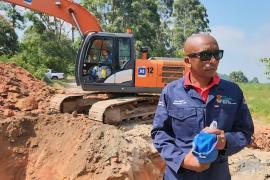
Assessments and monitoring of the Senteeko Dam is ongoing with pressure on the dam wall slightly reduced, following the construction of an emergency spillway last week, to release excess water.
The Senteeko Dam, officially registered as My Own Dam and commonly known as Senteeko Dam, is at high risk of failure, following recent heavy rainfall in the region.
While interventions are underway, including the emergency spillway and sandbags placed to prevent overtopping, the Department of Water and Sanitation (DWS) has warned that it is too early to declare the dam safe.
Head of the Specialist Unit: Dam Safety at the department, Wally Ramokopa, said significant risks remain despite the progress made so far.
Ramokopa joined a team of engineers and the Approved Professional Person (APP) on Monday to continue the ongoing assessment and monitoring of the dam, which is located near Barberton in Mpumalanga.
An Approved Professional Person is an engineer registered with the Engineering Council of South Africa (ECSA) and specifically approved by the Minister of Water and Sanitation.
Speaking to SAnews at the dam site, Ramokopa said water levels have dropped slightly since excavation began, but the department remains concerned.
“As you can see, the interventions are still ongoing. Excavation equipment has been brought to the site so that we can try to reduce the water level as much as possible, but at this stage it has only dropped a little bit.
“The capacity is still high, [and] the volume of water that is still flowing could have significant impacts. We are not happy yet, and we are not going to declare this dam safe because we have seen downstream underneath the material continuing to fall due to instability,” he said.
Ramokopa said a second spillway would be opened this week.
Engineers are currently widening it before excavating deeper to allow more water to be released in a controlled manner.
“We want to control the speed of the release because if water flows out too quickly, it might cause damage. That is why engineers are on site to guide the operators on how and when to do it. If we leave this to a person who does not have the necessary knowledge, we may trigger a failure unintentionally,” he told SAnews.
Evacuation measures
Ramokopa sought to allay fears among neighbouring communities, emphasising that only residents within the floodplain, especially the farming communities, may need to evacuate.
“We don’t have densely populated communities downstream. There are no townships, towns, or villages directly in the flood path. We are fortunate in that regard. People in Barberton should not panic, as they are far from the floodplain.
“Most people who would know when this dam is spilling are people who are using this water for irrigation purposes,” he said.
He said communities in Mozambique and the Kingdom of Eswatini would not be affected, noting that the nearest international border along the flood path is more than 160km downstream.
“There is no reason for neighbouring countries to be alarmed at all.”
Responsibility for the dam
Ramokopa said the dam owner remains responsible for it's maintenance and repairs.
“This is a privately owned dam. It does not belong to government. However, any work carried out must be authorised by the Department of Water and Sanitation because we issue licences for dam construction and repairs.
“If repairs are required, the Appointed Professional Person [employed by the dam owner] knows they need to design the work properly and submit the plans to the department for approval. Even if there would be any repair work conducted, it would not be done without our knowledge, [and] if that happens, that would be unlawful,” he explained.
Ramokopa said a WhatsApp group has been established to facilitate communication between the department, engineers, and the dam owners.
“For now, our priority is to ensure that we avoid failure and protect lives. We also need to engage with downstream land users about long-term stability, because the situation cannot be left as it is. If they do, we risk further flooding, this year or next year. Something has to happen, but for now, our focus is on ensuring that we do not lose lives in the event,” he said. – SAnews.gov.za


