


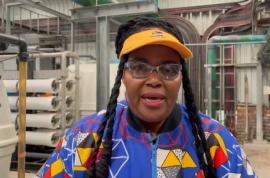
Water and Sanitation Minister Pemmy Majodina has announced an emergency relief allocation of R20 million to the Knysna Municipality, as part of urgent interventions to address the town’s deepening water crisis.
Majodina announced the allocation following a two-day working visit to the Garden Route District Municipality in the Western Cape, to assess the status of water challenges.
Majodina said the funding, drawn from reprioritised water services infrastructure grants, will be used alongside technical support from the Department of Water and Sanitation (DWS) to develop groundwater resources and ease pressure on Knysna’s strained surface water system.
Knysna’s water supply system is currently facing critical water shortages due to a severe localised drought affecting the Garden Route belt in the Western Cape.
The municipality’s primary water storage facility, the Akkerkloof Dam, is currently sitting at approximately 16% capacity, translating to an estimated 13 days of water at current consumption levels. The situation has been worsened by years of inadequate maintenance of water infrastructure, high non-revenue water losses and ongoing vandalism.
During her two-day visit on 17-18 January 2026, Majodina, accompanied by Knysna Executive Mayor Thando Matika and technical teams from both the municipality and DWS, conducted inspections at key water infrastructure sites. These included the Akkerkloof Dam, the Karatara River and several boreholes, to assess their potential for revival and additional yield.
While the low levels at Akkerkloof Dam have brought the crisis into sharp focus, technical assessments revealed that Knysna’s water challenges date back to at least 2023.
According to DWS, sufficient water resources could meet the town’s needs if leaks in the municipal distribution network were reduced and per capita consumption lowered. However, long-standing neglect of infrastructure asset management has left the system vulnerable.
Majodina supported the municipality’s decision to classify Knysna as a disaster area, noting that the request to the Western Cape Provincial Government to also declare Knysna a disaster area, will allow government to reprioritise resources and personnel from various sectors to address the situation.
“It will also assist government to have a co-ordinated and comprehensive approach and response to the water crisis,” the Minister said.
The department is also providing technical engineering expertise to assess the refurbishment requirements of the Knysna Desalination Plant, with the aim of increasing water supply.
The department is further assisting the Knysna Municipality to strengthen its water resources planning and has funded feasibility studies for a new small local dam to meet its longer-term demand.
The Minister urged the municipality to urgently develop a plan to tackle water leaks and install functioning water meters, which are major contributors to the high non-water revenue.
She also encouraged the exploration of alternative water sources, including groundwater, seawater desalination and water reuse, to reduce reliance on surface water.
The Minister highlighted that the department has previously provided support to the Knysna Municipality to assist with refurbishment and upgrading of some of its water supply infrastructure.
“The department allocated R12.4 million and R7 million during the 23/24-24/25 and 25/26 financial years respectively, through its Water Services Infrastructure Grant (WSIG), for the rehabilitation of existing water networks and for water conservation and demand management,” the Minister said.
During an engagement with the Knysna Business Chamber, Majodina commended the sector’s commitment to be part of the structures set up to solve the water challenges facing the tourist town.
The Knysna Business Chamber pledged to assist through mobilising its retired technical experts to contribute to resolving the water crisis.
Matika welcomed the department’s intervention and commitment demonstrated by the Minister in availing special emergency relief funding and technical support to address the municipality’s water challenges.
The mayor said the Minister’s hands-on engagement, together with the Department’s immediate, medium- and long-term interventions, complemented by provincial support, signals a strong, coordinated, and collaborative approach across all spheres of government to ensure water security for the Greater Knysna area.
“We further acknowledge and value the ongoing support and cooperation from both the Western Cape Department of Local Government and the National Department of Water and Sanitation, whose involvement strengthens the collective response to the current water crisis. This partnership demonstrates government’s shared responsibility to protect communities, sustain economic activity, and build a more resilient and sustainable water future for Knysna,” Matika said.
The department said it will continue to work closely with the municipality, provincial authorities and other stakeholders, and will provide regular updates to residents as interventions are implemented. – SAnews.gov.za


