


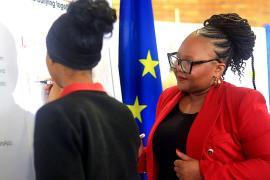
Basic Education Minister Siviwe Gwarube has called on parents, communities and government to work together to curb violence in schools, stressing that learner safety is fundamental to quality education.
“Both parents and the community need to work together in curbing violence. This can only be achieved as a collective,” the Minister said during a back-to-school engagement at Eldorado Park Secondary School on Monday.
The engagement placed learner safety, anti-bullying efforts and the prevention of gender-based violence (GBV) at the centre of the back-to-school programme.
Gwarube was joined by the Director-General of Basic Education, Mweli Mathanzima, Gauteng MEC for Education and Sports, Arts, Culture and Recreation, Matome Chiloane, and European Union (EU) Ambassador to South Africa, Sandra Kramer.
In her keynote address, Gwarube highlighted the direct link between school safety and effective learning, noting that unsafe environments undermine dignity and academic progress.
“The safety of children is a global priority, and SA is not alone in this fight. School safety is not a side issue. It is a precondition for quality education. When schools are unsafe, learning suffers. When learners feel threatened, dignity is stripped away. When violence becomes normalised, we fail our children,” Gwarube said.
During her address, the Minister announced that the European Union has committed €5 million (approximately R95 million) towards a national programme aimed at preventing and responding to gender-based violence in South African schools.
“The funding is meant to help schools not only react to violence but also prevent it and support learners who are affected,” Gwarube said.
The programme, implemented in partnership with United Nations Children's Fund (UNICEF), United Nations Educational, Scientific and Cultural Organisation (UNESCO) and the Foundation for Human Rights, will focus on equipping schools, parents, community leaders and learners with tools, policies and referral mechanisms to identify, prevent and respond to gender-based violence.
Kramer said the initiative seeks to create safe, inclusive and child-friendly learning environments.
She said the funding will strengthen prevention education, psychosocial support, such as counselling for traumatised learners, improved referral systems for abuse cases, and school-based interventions aimed at protecting pupils and addressing violence before it escalates.
By highlighting the partnership with the EU, Gwarube emphasised that protecting children is not only a national responsibility but a shared global concern.
Highlighting the broader response to violence and bullying, the Minister stressed the importance of strong leadership, collaboration with law enforcement and social partners, and a culture that prioritises prevention, accountability and dignity for survivors.
“School safety to us is not just a science. It’s a precondition. As government, we are clear: schools must be places of care, discipline and respect. Learners must feel confident that they are safe,” the Minister said.
As part of the programme, matric learner Zakia Abrams led fellow learners in reading the School Safety Pledge, committing to refrain from bullying, digital abuse, gang involvement, alcohol and drug use, and sexual harassment. The pledge was subsequently signed by the Minister, learners and dignitaries.
“We will publicly sign a commitment to achieve the education we need, not just for children, but as a promise that women are safe. We will listen when children speak, and we will build schools where respect, dignity and learning come first. Our priority is to create safe schools for all,” Gwarube said.
Director of School Safety at the Department of Basic Education, Sifiso Ngobese, outlined plans to strengthen governance, learner wellbeing and safety through restoring the functionality of School Governing Bodies, equipping teachers for trauma-informed classrooms, and addressing challenges such as bullying, teenage pregnancy and substance abuse.
UN Resident Coordinator Nelson Muffuh welcomed the initiative, saying the EU-funded programme, with UNESCO and UNICEF, would strengthen school safety, teacher training, psychosocial support and community engagement, while ensuring sustainability under South African leadership.
Chiloane underscored the importance of discipline, accountability and community involvement, noting that government investment alone cannot guarantee safe schools without active community participation. – SAnews.gov.za


