


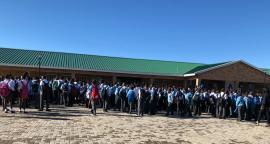
As the 2026 academic year is set to get underway soon, Higher Education and Training Deputy Minister, Dr Mimmy Gondwe, has urged learners and students to put their best foot forward academically in order to make their dreams a reality.
“My message to students and learners is stay focused [and] study hard. Be curious and don’t be afraid to dream. Dream big. I tell you; education is a weapon you can use to make sure that you become somebody tomorrow,” the Deputy Minister said in an interview with SAnews.
She added that education has the power to turn one’s fortunes around.
“Education really makes a difference, and it’s able to ensure that even as a woman, you have a brighter future and are not just relegated to the back. If you see me being anybody today, it’s because I worked hard at school and I prize education,” she said.
Last September, the Minister of Higher Education and Training, Buti Manamela, said that the department was projecting about 235 000 first-year university spaces. While access to higher education has improved over the years, he noted that dropout rates, particularly in the first year of study, remain high.
With prospective students likely still looking for spaces at various higher education institutions across the country, Deputy Minister Gondwe urged those still searching to be wary of bogus institutions.
“These are colleges that have not been registered; some are registered, but they are offering programmes that are not accredited. We get a lot of complaints around that from members of the community and students themselves.”
She added that such institutions prey on young people and their parents, noting that the department also engages matric learners on the dangers of bogus colleges.
“We also highlight that you not only lose out on an opportunity to get a proper legitimate qualification, but you also lose out on money and the opportunity to gain employment. We even extended that programme to cover high schools. So, we go speak to students in matric before they come into our sector to warn them about bogus colleges.”
She said that learners and prospective students can write to her helpdesk by emailing Dmsdesk@dhet.gov.za or visit the Department of Higher Edication and Training (DHET) website to check registered institutions: https://www.dhet.gov.za/SitePages/DocRegisters.aspx
At the media briefing held in September, Manamela stressed that the university spaces projected cannot absorb every qualifying learner and that learners should explore multiple options.
Other options
“Learners must recognise that SETAs (Sector Education and Training Authorities), TVET (Technical and Vocational Education and Training) colleges and CET (Community Education and Training) colleges are equally important pathways into work, skills, and further study,” the Minister said at the time.
In the interview with SAnews, Gondwe said that “we are trying to rebrand our community colleges to make them attractive, the same with our TVETs.”
“We still have a lot of students who want to go to university because there’s this misconception that if you end up at a TVET or community college, you’re never good enough for university. We want to make those institutions just as attractive as your universities.
“Students at community colleges don’t get funding from the NSFAS [National Student Financial Aid Scheme], so what tends to happen is that they have a high dropout rate. So as soon as a student gets a job somewhere, they leave. We are trying to rebrand them, and we want to make a case for them to get more in terms of the budget,” said Dr Gondwe.
The Deputy Minister is also looking to engage with bodies such as the Agricultural Research Council, an agency of the Department of Agriculture, to help community colleges in establishing viable food gardens and similar initiatives. The council conducts research with partners, develops human capital and fosters innovation to support and grow the agricultural sector.
"Community colleges are sometimes frowned upon as if they're the last frontier.”
While some young people are scrambling to secure spaces at institutions of higher learning, others have not yet been accepted at their universities of choice.
Central Application Service
Students who require guidance in navigating entry into the PSET system are encouraged to make use of the Central Application Service (CAS). In previous years, the department implemented the Central Applications Clearing House (CACH) as a short-term intervention to match unplaced applicants with available spaces.
From the 2026 academic year, CACH will not be implemented, as part of a broader reform of the PSET application process.
CAS has been designed as a more comprehensive, integrated and long-term solution to improve access, visibility and coordination across the entire PSET system.
CAS will progressively make visible a wider range of pathways beyond traditional university and college routes, while also helping to eliminate bogus institutions and protect prospective students from exploitation.
Students seeking information, guidance and support can WhatsApp the CAS Chat number 081 308 4196.
For the CAS Learner Guide go to https://www.gov.za/sites/default/files/gcis_documents/CAS_Learner%20Guide.pdf.
The Deputy Minister stressed that learners also have the options of SETA’s, TVETs and private institutions.
“And I know that not everybody can afford it; I do know that they do present an alternative in terms of being able to provide someone with access to higher education and training. University is not the only option.”
The Deputy Minister urged learners who did not pass their matric to enrol at community colleges and rewrite their examinations.
This as Manamela said that more than 130 000 learners were enrolled in CET programmes that range from the Second Chance Matric Programme, adult literacy and numeracy and skills programmes at CET colleges. At the briefing in September 2025, the department said it is working on repositioning CETs as centres of lifelong learning through investment in lecturer training, the timely delivery of learning and teaching support materials, and the rollout of digital access tools to support students, especially those in second-chance matric programmes.
Last September, the department called for nominations to fill vacancies on CET College Councils across the country. At the time, the department said the call represented an important step in strengthening the governance, accountability, and renewal of the colleges.
In addition, the country’s 21 SETAs also provide pathways for matric graduates, young people not in employment, education or training, and for workers seeking to reskill or upskill. This is done through learnerships, apprenticeships, bursaries and workplace training programmes in sectors ranging from engineering and construction to information and communications technology (ICT), hospitality, health and agriculture.
The list of the country’s SETA’s can be accessed on: https://www.dhet.gov.za/SitePages/SETAlinks.aspx
Young people can register on SETA databases, approach accredited training providers, or apply directly for learnerships and bursaries.
For learners wanting to improve their matric results, the Department of Basic Education’s (DBE) Second Chance Matric Programme is available. It was established in 2016 for learners who would like to improve their results or eventually complete their matric qualification on a part-time basis.
The aim of the programme is to provide support to learners who have not been able to meet the requirements of the National Senior Certificate (NSC) or the extended Senior Certificate (SC). NSC candidates can only register at their nearest district office for the programme.
Eligible individuals may register to rewrite or add subjects without any payment, in accordance with the DBE’s policies for the May/June examination cycle.
Registration for the programme opened on 1 October 2025 and will close on 6 February 2026.
In addition, the DBE provides an online service for (NSC) candidates to request a re-mark or re-check of examination scripts. This as the DBE is set to release the 2025 Matric Results on Monday, 12 January 2026. Results of the exams will be released to candidates on 13 January 2026.
In order to request a re-mark or re-check service, candidates must first register on the e-Gov portal at www.eservices.gov.za to create a personal account. This account will allow the candidate to login using their password and usernames to access the service.
“Registration can be done at either the school or district office in the province or online,” the DBE said.
The opening date for applications for re-marking and re-checking is 13 January 2026 with the closing date set for 27 January 2026 for both manual applications and online applications. The fee for re-mark is R120 per subject and re-checking is R30 per subject.
The viewing of scripts may only be done after a re-mark or re-check of results. The closing date for applications is 7 days after release of re-mark or re-check results. The fee for viewing is R230.
Results of remarking will be released from 13 March 2026 and will be available at the school/exam centre where the candidate sat for their 2025 examinations.
“Do not despair; reach out to us, and we’ll be able to tell you what the available options are for you. There’s hope for you in this sector,” said the Deputy Minister.
As learners return to the classroom on 14 January 2026, society can cheer them on in their respective journeys. - SAnews.gov.za


