


South Africa’s quality councils have issued a nationwide warning to learners and parents to verify institutions and qualifications before registering for post-school education and training in 2026, as fraudulent and unaccredited providers continue to target the public.
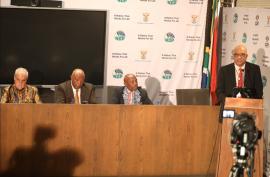
The call was made on Friday during a joint media briefing of the Quality Council for Trades and Occupations (QCTO), the Council on Higher Education (CHE), Umalusi, and the South African Qualifications Authority (SAQA).
At the briefing in Pretoria, the entities stressed that while the country’s education system remains credible, the rise of bogus institutions poses a serious threat to learners’ futures and families’ finances.
WATCH |
Umalusi chief executive officer (CEO), Dr Mafu Rakometsi, warned and emphasised that no school public or private, may operate or issue qualifications without being properly registered and accredited.
He noted that while the majority of schools comply with legislation, Umalusi continues to encounter illegal operators who promise “quick” matric certificates or shortcuts into the National Senior Certificate (NSC) system.
“Parents and learners must understand that only institutions registered with the provincial education departments and accredited by Umalusi may offer qualifications such as the NSC and NCV [National Certificate Vocational],” Rakometsi said.
He warned that fraudulent matric rewrite centres, back-room tuition centres, and institutions using misleading names often emerge during the matric results period, preying on anxious learners.
“There are no shortcuts in achieving a credible qualification. Any organisation that claims to issue a matric certificate without proper registration is deceiving the public,” said the quality assurance body CEO.
Occupational training targeted by scammers
QCTO CEO Vijayen Naidoo issued a firm warning against institutions falsely claiming to offer occupational certificates or the historic “Red Seal” trade test.
“As opportunities grow in the occupational training space, so does the number of unaccredited and bogus institutions claiming to offer QCTO certificates. Let us be clear: a QCTO qualification is only valid if it is offered by a QCTO-accredited skills development provider and assessed through a QCTO-accredited trade test or assessment centre,” he said.
Naidoo said the QCTO currently has over 900 occupational qualifications and part qualifications registered on the NQF, all developed by industry and aimed at boosting employability and productivity in key sectors, including new and emerging occupations such as renewable energy, solar photovoltaic installation, and hybrid vehicle technologies.
However, he cautioned that fraudulent providers many of whom are operating online continue to lure learners with promises of guaranteed certificates, fast-track trade tests and “Red Seal” qualifications without assessment.
“If something sounds too good to be true, it is a scam,” he said.
Naidoo also revealed that the QCTO has uncovered “unscrupulous activities” even among some accredited skills development providers and trade test centres. Action is being taken in collaboration with SAQA, the Department of Higher Education and Training (DHET), and law enforcement agencies.
Transition from pre-2009 ‘legacy qualifications’
The QCTO is currently managing the national transition away from outdated pre-2009 qualifications. While all already-achieved legacy qualifications remain valid, students who have not yet completed them must take note of the tightened timelines.
The last enrolment for pre-2009 qualifications is now June 2026, with completion deadlines extending between June 2027 and June 2029, depending on programme-specific teach-out periods.
Students still on these pathways are urged to consult their training providers about transitioning into the modern occupational qualifications through the national credit accumulation and transfer system.
Call for due diligence
CHE CEO Dr Whitfield Green reaffirmed the credibility of South Africa’s higher education system but warned that capacity constraints and the existence of bogus institutions make vigilance essential.
Of the more than 815 000 candidates who sat for matric exams this year, the post-school education and training system can only absorb about half placing many young people in the crosshairs of illegal operators.
“No institution purporting to be a higher education institution can offer qualifications unless those qualifications are accredited by the Council on Higher Education and registered on the National Qualifications Framework,” Green said.
South Africa has 26 public universities and about 145 registered private high education institutions. Unregistered private colleges operating outside this system are illegal, and their qualifications have no standing.
Green urged prospective students to verify qualifications on:
• the SAQA website (NQF registration),
• the DHET Register of Private Higher Education Institutions, and
• the CHE’s official accreditation listings.
“There is no grey area. If it is not accredited by the CHE and not registered on the NQF, it is an illegitimate qualification,” Green said.
Sector developments
The CHE announced several key developments expected to reshape South Africa’s higher education landscape, including:
• A new policy on institutional types published in May 2025, allowing for public and private universities, university colleges, and higher education colleges.
• A revised Higher Education Qualifications Sub-Framework to be published in the coming months.
• A new policy for collaborative or joint qualifications, enabling local and international institutions to jointly offer programmes.
• A sector-wide review of hybrid and blended learning modes following shifts observed after COVID-19.
• A comprehensive national review of initial teacher education qualifications scheduled for 2026.
Appeal to the public
During the briefing, CHE Communications Manager Ntokozo Bhengu made an appeal, highlighting the devastating effect bogus institutions have on families especially in rural areas.
“It saddens us when you find a student from a rural area whose parents had to sell livestock to pay for tuition, only to discover upon graduation that the qualification is not registered. The student has been duped and scammed, and the parents have lost money. By then, the kraal is empty. There is not a single cow left because they were trying to invest in the future of their child.
“We plead with the media to help us elevate the message and spread it across the country so that it reaches all students and parents to avoid this unnecessary pain and suffering,” Bhengu urged.
Verify before you register
The entities concluded the briefing with a unified message to the class of 2025, parents, teachers, and community leaders to verify the institution, and the programme offered because their future is too important to risk.
Accredited qualifications and providers can be checked on the:
• QCTO website: www.qcto.org.za
• SAQA qualification search
• DHET registers
The quality councils reaffirmed their commitment to protecting learners, strengthening employer partnerships, and closing the space for fraudsters. – SAnews.gov.za


