


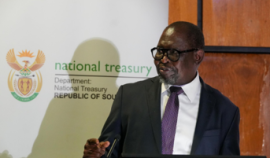
Minister of Finance Enoch Godongwana has called on the continent to strengthen the resilience of its health financing whilst strategically weaning off external financing that has become less reliable.
“We must ensure that health financing is sustainable, not just for a single financial year but for generations to come. This means strengthening our own domestic resource mobilisation and finding innovative ways of financing our health sectors,” Godongwana said on Thursday in Johannesburg.
He was addressing the African Union (AU) Commission’s 8th Session of the Specialised Technical Committee (STC) on Finance, Monetary Affairs, Economic Planning and Integration.
The STC brought together Ministers of Finance, Monetary Affairs, Economic Planning and Integration, as well as Health Ministers, central bank governors, senior policymakers, experts, and development partners to deliberate on strategies to close Africa’s health financing gap while responding to emerging global economic shifts.
“Coordination between the finance and the health sector has never been more important due to experiences from the COVID-19 pandemic.
“Our continent’s health sector is facing a phalanx of multiple crises. It is underfunded, overstretched and faces a distressing decline in Official Development Assistance (ODA).
“This challenge adds on the existing increase in our debt-service obligations and diminished fiscal space to make available for domestic health spending,” the Minister said.
He encouraged the continent to explore a range of solutions, including increasing budgetary allocations, and committing to increasing the share of national budgets dedicated to health, in line with the Abuja Declaration.
“There is a need to explore innovative fiscal policies to increase revenue, through targeted taxes on products harmful to health, such as tobacco and alcohol and improve the efficiency and transparency of our public financial management to make sure that every resource allocated for health is used effectively.
“Our private sector should not be left behind. We should create an enabling environment for both our public and private sectors to join hands and unlock investment and explore public-private partnerships across the healthcare infrastructure value chain,” the Minister said.
He pointed out that the continent’s health financing gap is an issue of global inequality.
Through South Africa’s Group Twenty (G20) Presidency, government is using the platform to support a new global compact on health financing, a model that is proactive and not crisis driven and is solidarity based.
“We are pushing for reforms to the global financial architecture to make it more equitable and representative. A key priority of our G20 Presidency is addressing the unsustainable debt burdens that destroy developing economies and prevent developing economies from investing in critical public services, including healthcare.
“We are proactively promoting a global framework to combat illicit financial flows and to ensure a fair and just international tax system. This will unlock billions of dollars in revenue that are currently lost to our economies, and funds that could be reinvested in our health systems in strengthening primary healthcare, and in building a resilient health workforce,” Godongwana said.
He stressed that the continent must urgently stabilise its economies by strengthening domestic markets, bolstering institutions and accountability, and protecting the vulnerable.
“Whilst it is true that the world economy is undergoing fundamental changes as demographic shifts and technological advancements reconfigure global markets, this moment too is a transitory one. There are new opportunities for change and growth on the African continent. A new thumping pulse in our veins, if you will.
“The energy transition and new technologies, including artificial intelligence, create new prospects for development and global economic interaction. The prospect of a multipolar world presents the African continent with opportunities to break free from old modes of development and trade,” the Minister said.
With new investments and new sources of investment finance emerging, he said there are opportunities to draw upon new spaces for pragmatic policy experimentation and autonomous development.
“New forms of multilateral cooperation and new partnerships for development are being forged, quite literally as we speak. Africa holds the keys to the solutions for the challenges the world faces. Africa’s youth are striving for development across the continent, demanding change.
“The continent’s critical minerals, renewable energy advantages, agricultural land, and biological resources make it a central pillar of tomorrow’s healthier world, and an indispensable partner in achieving it,” the Minister said.
He said a new and reimagined developmental approach is required that restores confidence in the promise of development as an empowering partnership.
“Africa can again be the flywheel around which a new vibrancy can emerge. This calls for new principles of global co-operation, more effective global finance for investment and economic transformation in Africa.
“The old development models will no longer work, and the era of aid is largely over. I agree entirely, African countries must now approach development through the lens of sharper investment discipline,” Godongwana said. - SAnews.gov.za


