


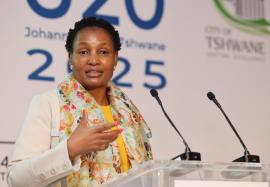
Human Settlements Minister Thembi Simelane says investing in formal housing and the transformation of informal settlements are critical contributions to infrastructure development and economic growth.
Simelane made the remarks during the Urban 20 (U20) Mayors Summit, held in Sandton, on Saturday.
The U20 seeks to strengthen engagement between the G20 and cities, raise the profile of urban issues on the G20 agenda, and create a platform for cities to develop a collective message and perspective to inform G20 negotiations.
Speaking in a panel discussion on “Local Economies as Engines of Inclusive Development: A New Vision for Governance and Informality through Equitable Climate Action and Public Service Provision”, Simelane called for a paradigm shift on how investors and financial institutions perceive informality in relation to its economic potential.
“Investments in supporting township economy is a contribution to economic growth with potential positive spin-offs such as job creation, improved living standards, and quality of life,” the Minister said.
She warned that financial exclusion of informal enterprises continues to stifle growth and innovation, leaving many promising enterprises unable to scale or compete with more established, formal businesses.
“Addressing these barriers through micro-investment ecosystems and enabling entrepreneurial innovation can unlock sustainable township economic development and greater inclusion in national growth,” Simelane said.
To advance the agenda on local economic development and transformation of informality in cities, Simelane highlighted that the 2024 White Paper for Human Settlements advocates for the implementation of developmental interventions.
Among the interventions include:
• Infrastructure development projects that are packaged to target areas with Transit-Oriented Development with concentration of growth around frequent public transit corridors by locating housing, offices, shops, schools, and services near metro stations and bus hubs.
• The transformation of existing townships, and areas which have been established since the 1980s, into sustainable human settlements.
• Focus on the elimination of spatial monotony and the general character of these areas as low-income dormitory suburbs, improving quality of the living environments, including greening the environment, and unlocking township residential property market, through streamlined land transfer and planning processes.
Shaping municipalities’ economies
The Minister urged municipalities to play a proactive role in shaping their respective economies. This requires inclusive stakeholder participation in developing strategies and plans, such as their integrated development models.
She noted that municipalities still grapple with deep economic and spatial disparities which are not only a historical injustice linked to apartheid, but also a geographical and environmental reality.
“Despite these differences, cities must take their own initiatives, as espoused in our Constitution, to share and distribute the economic benefits to their residents,” Simelane said.
She added that people should not only be connected to cities for employment but also for opportunities linked to decent and adequate housing, better living conditions, skills development, participation in manufacturing and entrepreneurial endeavours that generate production inputs, commercial networks, in order to promote and protect their human. – SAnews.gov.za


