


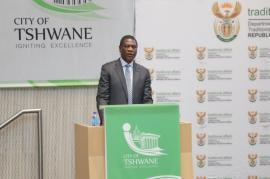
The South African Police Service (SAPS) and the Department of Traditional Affairs are diligently working to find alternative ways to protect traditional and Khoi-San leaders, Deputy President Paul Mashatile said on Friday.
Speaking at a dialogue between government and the National House of Traditional and Khoi-San Leaders (NHTKL), he said that this includes the possibility of opening mobile client service centres to better reach rural communities that are located far from police stations.
READ | Deputy President Mashatile to address traditional leaders' dialogue
The killing of traditional leaders was also an area of concern for those gathered at the dialogue held at Tshwane House in Pretoria on Friday.
“Another major issue that is of concern is the killing of traditional and Khoi-San leaders. In this regard, the Provincial Task Teams were established to work on this aspect. The South African Police Service and the Department of Traditional Affairs are exploring alternative options in terms of the protection of traditional and Khoi-San leaders,” said the Deputy President.
WATCH | Deputy President addresses traditional leaders dialogue
He further added that the SAPS is implementing the traditional policing concept in four provinces, namely Limpopo, KwaZulu-Natal, Eastern Cape, and Mpumalanga.
“The SAPS also provides services on wheels using mobile client service centres to reach out to rural communities that are far from police stations
“As we work towards addressing your needs, I urge you, Amakhosi, to never forget your mandate as leaders in our communities. Your commitment to promoting national unity, peace, stability, and community cohesion must be unwavering.
“In addition, you must build, protect, and promote community culture and customs,” he added.
As the backbone of communities, the country’s second-in-command said traditional and Khoi-San leaders play an important role in establishing a capable and developing state.
“Your knowledge, expertise, and deep relationships with the communities make you invaluable collaborators in furthering our country’s development objectives.
“Your direction and leadership are critical to ensuring that government policies and programmes are effectively implemented and reach those who require them the most.”
He stressed that government wants traditional leaders to participate in integrated planning, programme delivery and service delivery initiatives meant to benefit traditional communities.
“Across all spheres of government, we must promote collaborative partnerships between government and traditional leaders.”
He believes that the traditional leaders play an important role in addressing societal issues in communities.
“Your influence and authority can help address issues such as sexual offences, gender-based violence, substance abuse, and crime in our communities.”
Gender-based violence
As the country commemorates Women’s Month and Women’s Day on Saturday, 09 August, and remembers those who fought tirelessly against the pass laws, he urged traditional and Khoi-San leaders to stand against current challenges, including abuse of women and children.
“We must never tolerate anyone using the name of culture as a justification for mistreating women. To eliminate negative elements of traditional culture and promote gender equality in our communities, we must all support positive features of traditional culture.”
Partnerships
The Deputy President believes that dialogue is essential for strengthening the government’s partnership with traditional leadership.
He said this relationship serves as a direct link between the government and local communities, particularly those in rural and communal areas.
The Deputy President said government cannot make decisions that affect the leaders and their people without their involvement.
“As voices of your communities and guardians of tradition, we, as government, have to integrate you into the process of decision-making, ensuring your views are respected, especially in the areas of land, inadequate infrastructure, customary law, the fight against poverty, and community development.”
TKLB
In addition, he announced that the Department of Cooperative Governance and Traditional Affairs (CoGTA) will soon be engaging Traditional and Khoisan Leaders on the Traditional and Khoi-San Leadership Bill (TKLB) before it is approved by Cabinet for introduction to Parliament.
He described the TKLB as a critical piece of legislation that seeks to formally recognise the Khoi and San communities and their leadership structures, while also addressing the deficiencies of the Traditional Leadership and Governance Framework Act, No. 41 of 2003.
“Once enacted, the Bill will provide a legal framework to recognise and regulate traditional and Khoi-San leadership institutions, clearly outlining their roles, responsibilities, and engagement with government. This demonstrates both our commitment and responsibility as government to promote inclusive governance,” he said. – SAnews.gov.za


