


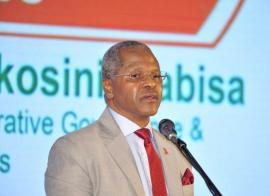
Cooperative governance and Traditional Affairs Minister Velenkosini Hlabisa has characterised the review of the White Paper on Local Government as one that is timely and urgent.
Speaking at the launch of the review of the white paper at the Premier Hotel OR Tambo, Kempton Park on Monday, the Minister said the launch represents a pivotal step in reimagining South Africa’s local government framework.
“Since the adoption of the original White Paper in 1998, South Africa has made significant strides, including improved access to basic services, the establishment of autonomous municipalities, and the strengthening of democratic participation.
“However, numerous municipalities continue to grapple with systemic challenges such as service delivery failures, fiscal mismanagement, and governance breakdowns,” he said at the launch in Gauteng.
He further emphasised the importance of confronting these challenges directly.
“The harsh reality is that several municipalities are unable to repair potholes, ensure access to clean water, or provide reliable waste management. Others fail to utilise grants effectively. This is unacceptable, and the Review of the White Paper provides a blueprint for transformative change.”
He said that of South Africa’s 257 municipalities, some are “financially unsustainable, lacking any revenue base - an outcome of legacy design flaws in our system.”
“As we reshape local government to be fit-for-purpose, we must seriously consider whether maintaining non-viable municipalities is justifiable.”
Government has identified local government as a key driver of its strategic priorities, which include inclusive economic growth, poverty eradication, job creation, and the promotion of ethical and capable governance.
READ | Hlabisa to officially launch the Review of the 1998 White Paper on Local Government
The Review of the White Paper is aligned with these objectives and focuses on the following strategic pillars:
• Structural reforms to enhance operational efficiency and accountability
• Deepened community participation and inclusive governance
• Ethical leadership and anti-corruption initiatives
• Strengthened intergovernmental coordination
• Recognition and integration of traditional governance structures
• Climate-resilient and spatially equitable development
A Discussion Document, released on 10 April 2025, outlines nine policy priority areas for transformation, including financial reform, the depoliticisation of municipal administration, and the reduction of spatial inequality.
The public have until 30 June 2025 to make their inputs into the document.
It can be accessed on : https://www.cogta.gov.za/index.php/docs/white-paper-on-local-government-1998-review-of-the-white-paper-on-local-government/
Minister Hlabisa emphasised that this review is not merely a technical or policy-driven exercise, but a national imperative requiring active citizen engagement.
“The journey toward a more capable and responsive local government system is a collective responsibility. We call on all stakeholders—residents, councillors, municipal employees, business leaders, and traditional leaders—to partner with us in redesigning this vital sphere of governance.”
A key theme of the review is the meaningful inclusion of the Khoi, San, and traditional leadership systems.
Minister Hlabisa reiterated that recognising these voices is not only a constitutional obligation but a critical step in developing culturally grounded and socially cohesive models of governance.
The review process commenced in October 2024 through extensive consultations with stakeholders across all sectors of society. These engagements informed the current Discussion Document.
Further rounds of public submissions, dialogues, and workshops will shape the revised White Paper, which is expected to be finalised and published by March 2026.
The Minister stressed that the success of the review relies on a whole-of-government and whole-of-society approach, with contributions required across all three spheres of government and from every segment of society.
Submissions can be directed via email to:
• WPLG26@cogta.gov.za
• RichardP@cogta.gov.za
• MaphutiL@cogta.gov.za
Alternatively, submissions can be sent via post or hand-delivered to the following addresses:
Postal Address:
Minister of Cooperative Governance and Traditional Affairs
Attention: Mr. Thabiso Richard Plank (WPLG26 Policy Review)
Private Bag X802
Pretoria, 0001
Physical Address:
87 Hamilton Street
Arcadia, Pretoria
- SAnews.gov.za


