

President Cyril Ramaphosa has unveiled far-reaching reforms to South Africa’s local government system, proposing a differentiated model of municipal powers and functions, stricter regulation of water and electricity services and stronger financial controls to address persistent service delivery failures.
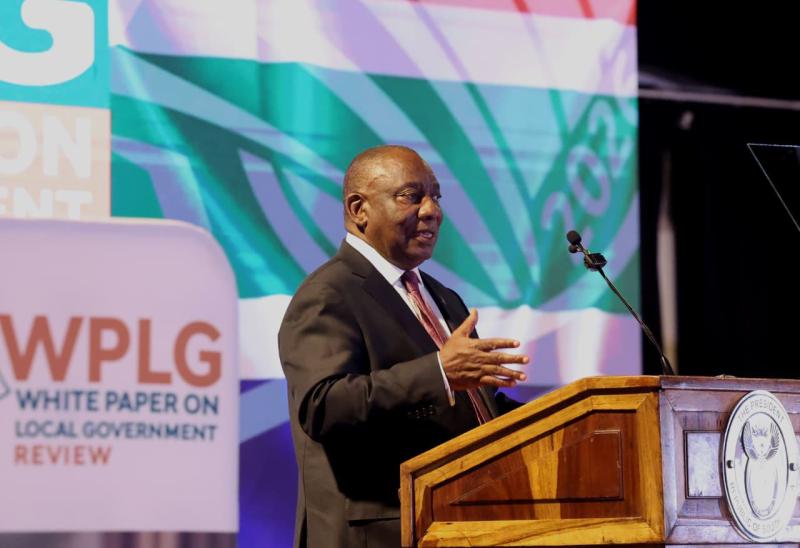
The Revised White Paper on Local Government was launched at the Birchwood Hotel and Conference Centre in Ekurhuleni on Thursday and sets out a fundamental reassessment of how municipalities are structured, financed, managed and held accountable.
The reforms seek to address systemic weaknesses that have left many municipalities struggling with deteriorating infrastructure, unsustainable finances, inadequate administrative capacity and unreliable basic services.
“This revised White Paper lays the foundation for far-reaching legislative, institutional and financial reform of the entire local government system.
“It is not simply about changing legislation or rearranging institutions. It is about changing the lived experience of our people,” President Ramaphosa said.
The launch, held under the theme: “Every Municipality Must Work: From Policy to Collective Action”, marks a shift from reviewing local government policy towards implementing reforms intended to strengthen municipal performance and improve the daily lives of communities.
It builds on the 2022 Presidential Local Government Summit, stakeholder consultations and the government’s broader reform agenda, including Operation Vulindlela.
Differentiated approach to municipalities
A key proposal in the Revised White Paper is to move away from the current uniform approach to assigning powers and responsibilities to municipalities, recognising that they differ significantly in size, revenue, institutional capacity and ability to deliver services.
Under the proposed model, municipal responsibilities would be aligned with the capacity of individual municipalities to perform them effectively.
The White Paper also proposes that some functions could be assigned to other spheres of government or delivered at regional level, while partnerships and concession arrangements could be considered where appropriate.
“The White Paper outlines a clear path towards a differentiated model that would link powers and functions to a municipality’s size, capability and performance.
“It calls for constitutional and legislative amendments to be considered where necessary to implement this,” the President said.
He acknowledged that the proposals represent a fundamental change to the local government system but said government needed to confront the reforms required to address the service delivery crisis in many municipalities.
The differentiated approach is intended to recognise that metropolitan municipalities, secondary cities, rural municipalities and small towns face different circumstances and cannot necessarily be expected to perform the same functions in the same way.
The proposed changes would require careful consideration of the constitutional and legislative framework governing local government.
The President said national and provincial government also has a responsibility to support municipalities and intervene where necessary to ensure that essential services were delivered.
“Our Constitution envisages local government as a separate sphere with its own powers and responsibilities.
“At the same time, it enjoins the national government to both support and regulate the work of local government, and to ensure that municipalities are able to fulfil their responsibilities effectively,” he said.
Changes to water and electricity provision
The White Paper proposes reforms to the provision of water and electricity, including separating the role of service authority from that of service provider and introducing compulsory licensing requirements for all water and electricity providers.
The proposals seek to strengthen the regulation of these essential services while expanding support to municipalities to improve their institutional capability and performance.
The President said the combination of stronger regulation and support would help transform the delivery of basic services.
The proposals come amid persistent problems with water supply, electricity infrastructure and municipal maintenance, which affect households, businesses and the broader economy.
President Ramaphosa said national and provincial government could not distance themselves from municipal failures, particularly when overlapping responsibilities, poorly coordinated investment and delayed support contributed to service delivery breakdowns.
“When mandates overlap, when investment is poorly coordinated or when support arrives only after a crisis, the entire system has failed the community,” he said.
The White Paper therefore calls for clearer responsibilities, recognition of the different circumstances of municipalities and earlier intervention when performance deteriorates.
Municipal finances under scrutiny
The financial sustainability of municipalities is another central pillar of the proposed reforms.
Municipalities owe Eskom more than R120 billion, while many are also in arrears to water boards, highlighting the financial pressures affecting the local government system.
The White Paper proposes stronger financial management, improved revenue collection, reduced losses and more effective spending to ensure that available resources translate into better services.
President Ramaphosa said municipalities need credible and sustainable financial arrangements that reflect their different economic circumstances and revenue-generating capabilities.
“A metro, a growing secondary city and a rural municipality with a limited revenue base do not face the same conditions.
“We must therefore organise responsibilities, resources and support more intelligently, so that every municipality has a credible path to success,” he said.
Another major proposal is to ring-fence revenue generated from the sale of water and electricity to ensure that the money is prioritised for maintaining the infrastructure needed to provide these services.
“Going forward, revenues from the sale of electricity and water will be ring-fenced and used to maintain infrastructure before anything else,” the President said.
He said this would help restore municipal infrastructure to an acceptable standard and ensure that it remained functional for future generations.
The President warned that municipalities could not continue investing in new infrastructure while neglecting existing assets.
“We cannot build our way out of failure if we do not maintain what we have already built,” he said.
He said maintenance needed to become a planned, funded and monitored obligation rather than an afterthought once infrastructure had broken down.
Additionally, a reliable water network, electricity system, road network and wastewater treatment plant are economic assets and instruments of social justice.
The President also emphasised that residents who could afford to pay for services should contribute towards their provision, while municipalities needed to earn public confidence through reliable services, transparent decisions and responsible management of public funds.
Coordinated implementation across government
The Revised White Paper also proposes treating local government as an integrated system, requiring national departments, provincial administrations, municipalities and state-owned entities to coordinate their planning, budgets and investment around shared priorities.
The District Development Model, which seeks to bring government and its partners together around priorities in districts and metropolitan areas, is expected to play a role in strengthening this coordination.
President Ramaphosa said the constitutional principles that define the three spheres of government as distinctive, interdependent and interrelated needed to be reflected in the way government plans, budgets and builds.
To drive implementation, Cabinet has endorsed a phased approach supported by a time-bound Local Government Transition Management Body, with coordinated leadership from the Department of Cooperative Governance and Traditional Affairs, The Presidency and National Treasury.
The body will be responsible for ensuring that reforms are coordinated, difficult decisions are taken and commitments are implemented.
It will not take over the lawful responsibilities of Ministers, provincial governments, municipal councils or municipal administrations.
A single Local Government Transition Plan will set out the reforms, identify the institutions responsible for implementing them, establish the sequence of actions and provide a framework for monitoring progress.
Some measures will require legislation, new financing arrangements, additional institutional capacity and potentially constitutional amendments.
The President said these processes would require careful consultation and disciplined implementation but stressed that work needed to begin immediately.
Local government reform and economic growth
The White Paper places the relationship between functioning municipalities and economic growth at the centre of the reform agenda.
The President highlighted that municipalities need to create an environment in which businesses can operate, investment can take place and where communities can access economic opportunities.
“A growing economy needs towns and cities that work.
“Investors need certainty. Entrepreneurs need predictable municipal decisions. Workers need reliable and affordable access to opportunity,” he noted.
President Ramaphosa explained that effective water and electricity provision, transport, land-use planning and local regulation are essential to attracting investment and supporting economic activity.
“When they fail, they deepen poverty and exclusion,” the President said.
The White Paper also calls for municipalities to strengthen their ability to plan for disasters, as floods, droughts and fires place increasing pressure on communities and infrastructure.
Rebuilding local government
The revised policy follows nearly three decades of democratic local government, established through the 1998 White Paper, which sought to dismantle the racially fragmented municipal system inherited from apartheid.
President Ramaphosa acknowledged the progress made in expanding access to basic services since 1994, but said persistent inequalities and municipal dysfunction required a fundamental reassessment of the system.
More than 90% of households have access to electricity, while more than 87% have access to piped water.
The number of households with municipal piped water increased from 9.2 million in 2004 to just under 16 million in 2025 while two-thirds of households have access to flush toilets and the free basic services programme continues to assist millions of indigent households.
However, the President said these gains exist alongside communities without adequate basic amenities, households experiencing unreliable services and municipalities unable to finance essential infrastructure repairs.
He added that the challenge is to ensure that local government fulfils its developmental mandate and improves the quality of life of all South Africans.
“The 1998 White Paper helped us establish democratic local government. The task before us now is to make developmental local government work as it was intended,” he said.
The reforms are intended to outlast individual administrations and electoral cycles, with the President calling for collective commitment from all spheres of government and society.
“This is a national undertaking that must outlast any election cycle, municipal term or administration,” he said.
The launch comes ahead of the Local Government Elections scheduled for 4 November, with the President urging registered voters to participate and political leaders to prioritise the functioning of municipalities once elected.
“A disagreement in council must never become an excuse for an unapproved budget, an abandoned project or the collapse of an essential service. Our people must never be held hostage by political instability,” the President said. – SAnews.gov.za


