


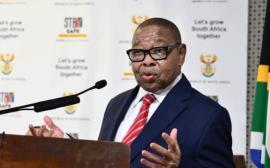
Minister of Science, Technology and Innovation, Professor Blade Nzimande, has called on Southern African Development Community (SADC) countries to move beyond exporting raw minerals and instead, build regional value chains that drive industrialisation, create jobs and strengthen Africa's economic sovereignty.
Speaking during a panel discussion on critical minerals at the SADC Industrial Week in Durban on Monday, Nzimande said the region's abundant mineral resources should become the foundation of future industries, rather than remaining commodities for export.
Referencing President Cyril Ramaphosa's remarks at the 2026 Africa Energy Indaba, Nzimande said Africa's vast reserves of critical minerals presented an opportunity to transform the continent's economy.
“President Ramaphosa emphasised that the promise of Agenda 2063 relies not just on universal access to energy, but on productive access. This is access that empowers African economies to move beyond merely exporting raw materials and toward localised value addition,” he said.
He said mineral beneficiation must become central to Africa's development agenda.
“Therefore, mineral beneficiation must sit at the absolute centre of Africa's economic conversation. Critical minerals are now the bedrock of economic growth, industrial competitiveness, energy security, and the global transition to clean technologies,” the minister said.
For the SADC region, Nzimande said the challenge was no longer the availability of critical minerals but how Member States could use them to build stronger economies.
“For us in the SADC region, the question is no longer whether we possess these critical minerals. The real question is how we leverage them to build resilient regional value chains, unlock widespread industrialisation, and create sustainable prosperity for our people,” he said.
Hydrogen and battery economy
Nzimande said the Department of Science, Technology and Innovation (DSTI) views critical minerals as strategic resources that underpin future industries, particularly the hydrogen and battery economies.
He said both sectors are central to South Africa's Decadal Plan for Science, Technology and Innovation (2022 – 2032) and support the country's just energy transition and inclusive economic growth.
To strengthen South Africa's hydrogen economy, he highlighted government's approval of the 15-year Hydrogen South Africa (HySA) Research, Development and Innovation Strategy in 2007.
The strategy aims to develop local expertise, skills and high-value hydrogen fuel cell technologies.
Nzimande said the department had established three Centres of Competence focusing on catalysis, hydrogen production, storage and distribution, and systems integration and technology validation.
According to the Minister, the centres have developed platinum group metals-based catalysts, membrane electrode assemblies for fuel cells and electrolysers, and metal hydride hydrogen storage technologies, strengthening South Africa's position in the global hydrogen market.
He also highlighted the recent handover of a Mobile Hydrogen Refuelling Station developed in partnership with North-West University and Toyota South Africa Motors to support the decarbonisation of the transport sector.
In addition, Nzimande officially opened the Rapid Prototype Training and Testing Facility, established with North-West University and African Rainbow Minerals, to accelerate the development of water electrolysis technologies from laboratory research to industrial application.
Advancing battery innovation
Nzimande said the department is also investing in South Africa's battery economy through lithium-ion battery development for energy storage and electric vehicles.
The focus, he said, includes developing value-added manganese precursor materials through the Energy Storage Research, Development and Innovation Flagship Programme to promote manufacturing, beneficiation, technology transfer and commercialisation.
He added that the department is working with the University of Limpopo and the Manganese Metal Company to develop battery-grade manganese sulphate from both manganese metal and manganese ore.
“These initiatives represent decisive steps toward strengthening South Africa's green hydrogen and battery innovation ecosystems. They also support the industrialisation of locally developed, publicly funded intellectual property through strong collaboration among government, industry, and academia,” he said.
Supporting government strategies
Nzimande stressed that the department's work is aligned with broader government strategies, including the Green Hydrogen Commercialisation Strategy, South Africa's Critical Minerals and Metals Strategy, and the South African Renewable Energy Masterplan (SAREM).
As part of this effort, the department has approved funding to secure Africa's first International Network of Wind Energy Measurement Institutes accreditation for the Council for Scientific and Industrial Research's Subsonic Wind Tunnel Facilities.
Nzimande said the accreditation would address a significant gap in South Africa's wind energy measurement infrastructure while reducing costs and delays for industry.
“It will also enable the CSIR to offer world-class wind speed sensor calibration services to the South African, SADC, and broader continental markets,” he said.
Nzimande said strengthening renewable energy capabilities would provide the enabling environment needed for the growth of the hydrogen and battery industries, both of which depend on specialised skills and locally available critical minerals such as platinum group metals, lithium, cobalt and nickel.
Building regional value chains
Looking ahead, Nzimande said the department's objective is to develop technologies, innovation capabilities and technical skills that enable South Africa and the wider SADC region to capture greater value from their mineral wealth.
“For SADC, this means a collective shift away from basic extraction toward integrated value chains in beneficiation, mineral processing, battery materials, hydrogen technologies, rare earth applications, and advanced manufacturing,” the minister said.
He said the region should position itself as a producer of advanced materials and green technologies rather than remaining primarily an exporter of raw minerals.
“Our vision is clear: SADC must become a resilient producer of advanced materials, hydrogen technologies, battery components, and manufactured products.
“By combining our vast mineral wealth with targeted science, technology, innovation, investment, and regional cooperation, we can build resilient industrial economies, create quality jobs, secure a meaningful place in global green value chains, and more fundamentally, safeguard the economic sovereignty of the African continent,” he said. – SAnews.gov.za


