


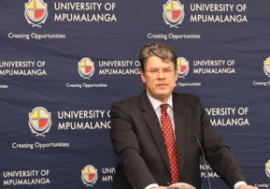
South Africa’s justice system must move beyond merely interpreting indigenous languages in courtrooms to developing them as languages of legal education, adjudication and jurisprudence.
This is according to Deputy Minister of Justice and Constitutional Development Andries Nel who delivered a public lecture on indigenous languages and the South African justice system at the University of Mpumalanga on Tuesday.
“Thirty years after the adoption of the Constitution, our task is not merely to praise its multilingual promise. It is to build the institutions through which that promise can speak.
“Let us ensure that every language of our people can become a language not only in which justice is heard, but through which justice is imagined, reasoned and made,” the Deputy Minister said.
Nel emphasised that language appears not at the margins of the Constitution but in Chapter 1, among its Founding Provisions.
“The constitutional wording is exacting. It identifies history, not linguistic inadequacy, as the source of inequality. It requires action, not ceremonial recognition. It requires measures that are practical and positive, not promises that remain permanently aspirational.
“Section 6 must also be read with equality, dignity, freedom of expression, cultural participation, education, access to courts and the right of an accused person to be tried in a language that the accused understands or, when that is not practicable, to have the proceedings interpreted,” he said.
Furthermore, a multilingual constitutional order would “requires more than interpreted access. It requires participation in the production of jurisprudence itself”.
“Translation remains essential, but it is not neutral. Translation is never the mechanical replacement of one word with another. It is an encounter between conceptual worlds.
“We [should not] assume that English legal concepts can simply be transferred into another language without being tested against its grammar, history and social experience.
“Translation, at its best, changes both sides of the encounter. It reveals assumptions that appear natural in the dominant language and creates new possibilities of legal thought,” Nel said.
Bridging the gap
Nel called for a phased language implementation strategy and proposed a partnership between the University of Mpumalanga, the South African Judicial Education Institute (SAJEI) and the Brigitte Mabandla Justice College to create a national centre of excellence for justice sector education, research and professional development.
The Brigitte Mabandla Justice College, he added, should “seriously consider signing a Memorandum of Understanding [MoU] with the University of Mpumalanga to strengthen the administration of justice.”
Such an MoU would be based on the following five pillars:
• Education and Training;
• Research and Innovation;
• Indigenous Languages and Access to Justice;
• Digital Justice, and
• Community Engagement and Public Legal Education.
“We could develop specialised justice programmes together in the form of joint short courses or postgraduate certificates on indigenous languages in the justice system; court interpreting and legal translation, plain language drafting of legal documents, customary law and constitutional law, access to justice in rural communities, and alternative dispute resolution rooted in indigenous knowledge.
“There is the possible establishment of a research hub: A collaborative research programme could examine language barriers in courts, access to justice, community justice systems, indigenous legal knowledge, and justice innovation.
“[We] could develop legal terminology in indigenous languages, create multilingual court resources, produce legal dictionaries and glossaries, support interpreter training, research language and access to justice; and advise government on language policy in the justice sector,” Nel suggested, among others.
He assured that even if it may take time, a multilingual justice system is possible.
“The rising sun does not abolish the night by declaration. Light grows across the landscape.
“In the same way, a multilingual jurisprudence will be produced through accumulated work: one concept clarified, one interpreter trained, one student taught, one textbook written, one judgment translated, one database enlarged, one institutional partnership sustained.
“Quantitative changes can, in time, become qualitative transformation,” Nel said. – SAnews.gov.za


