


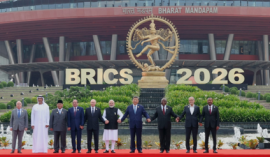
New Delhi, India -BRICS has expressed concern over the rise in unilateral tariff and non-tariff measures, saying such actions distort trade and are inconsistent with World Trade Organization (WTO) rules.
“The proliferation of trade-restrictive actions that are inconsistent with WTO rules, whether in the form of indiscriminate rising of tariffs and non-tariff measures, or protectionism under the guise of environmental objectives, threatens to further reduce global trade, disrupt global supply chains, and introduce uncertainty into international economic and trade activities, potentially exacerbating existing economic disparities and negatively affecting prospects for global economic development,” the BRICS New Delhi declaration said on Saturday.
The WTO oversees the global rules-based system that governs trade between nations.
India is hosting the 18th BRICS Summit, which began on Saturday under the theme: “Building for Resilience, Innovation, Cooperation and Sustainability”, reflecting a people-centred and humanity-first approach.
The grouping adopted the declaration on the first day of the Summit, which will conclude on Sunday in New Delhi, noting that the multilateral trading system has long been at a crossroads.
“We voice serious concerns about the rise of unilateral tariff and non-tariff measures which distort trade and are inconsistent with WTO rules.
“We will work together to enhance the WTO’s responsiveness to trade disruptions and the needs and priorities of emerging markets and developing economies (EMDEs), as well as advance discussions on outstanding issues, and support balanced, inclusive and concrete outcomes that strengthen the multilateral trading system and enable it to better address evolving global challenges,” BRICS said.
The grouping reaffirmed its unwavering support for reforming the World Trade Organization and strengthening a non-discriminatory, open, equitable, transparent, fair, inclusive, predictable and rules-based multilateral trading system, with the WTO at its core.
It also upheld foundational principles such as Most-Favoured-Nation Treatment and Special and Differential Treatment for developing members, particularly least-developed countries (LDCs).
“We remain committed to active engagement in multilateral negotiations in Geneva, especially in the debates regarding the reform of the WTO. We will advance efforts and enhance coordination under the BRICS Informal Consultative Framework on the challenges undermining the effectiveness and credibility of the WTO and solutions to these challenges,” BRICS said.
BRICS has expanded from its original membership of Brazil, Russia, India, China and South Africa to include Egypt, Ethiopia, Iran, Saudi Arabia, the United Arab Emirates and Indonesia as full members.
The 2025 partner-country framework includes Belarus, Bolivia, Cuba, Kazakhstan, Malaysia, Nigeria, Thailand, Uganda, Uzbekistan and Vietnam.
According to India’s BRICS Presidency, the 11 member countries account for about 49.5% of the world’s population, 40% of global gross domestic product and 26% of global trade.
The grouping provides a platform for consultation and cooperation on global and regional matters, including political, economic, financial and people-to-people cooperation. - SAnews.gov.za


