


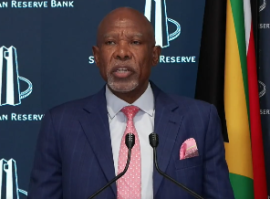
The South African Reserve Bank’s Monetary Policy Committee (MPC) has increased the repo rate by 25 basis points to 7%, effective from 29 May 2026.
SARB Governor Lesetja Kganyago said four MPC members supported the increase, while two preferred to keep the rate unchanged.
At a media briefing on Thursday, Kganyago said the committee acted because inflation risks had intensified and overlapping shocks could trigger second-round effects.
He explained that the decision was meant to manage those risks and help bring inflation back to target.
At this meeting, the MPC considered three main risk scenarios.
The first was a prolonged Middle East conflict, which could push up oil and food prices and weaken the rand.
The second was the possible emergence of El Niño, a weather pattern that often brings drought to parts of South Africa.
The third scenario considered non-linear effects, meaning large shocks could have an outsized impact on inflation as more costs are passed on to consumers.
Kganyago said all three scenarios pointed to higher inflation and weaker economic growth.
“The scenario with a longer Strait closure has inflation at about 5%, with two more hikes than the baseline. With El Niño added, rates stay high for longer. The most adverse scenario puts all the risks together, causing inflation to peak above 6%, requiring three extra hikes,” Kganyago said.
He said these scenarios highlighted the role of food and fuel in transmitting geopolitical shocks and showed the added risks posed by a severe El Niño.
The MPC has also raised its oil price assumptions and now expects renewed pressure on food prices, with the agricultural sector facing higher diesel and fertiliser costs.
“Looking forward, we have raised our oil price assumptions. In addition, we see renewed pressure on food prices, with the agricultural sector facing higher costs for both diesel and fertiliser. Our forecast now has headline inflation averaging 4.4% this year and 3.7% next year, before returning to the 3% target in 2028. Core inflation is also higher, peaking early next year,” he said.
Recent inflation data also reflected mounting price pressures.
In April, consumer inflation rose to 4%, up from 3.1% in the previous month, mainly because of higher energy costs.
Kganyago said fuel prices, after falling by 8.7% in March, increased by 11.4% in April, making it one of the biggest jumps in fuel inflation on record.
Services inflation also accelerated to 4.6%, well above the bank’s 3% target.
He said this was partly due to transport costs, but also reflected broader price pressures in areas such as insurance and financial services. -SAnews.gov


