


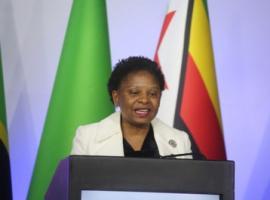
Minister in the Presidency Khumbudzo Ntshavheni has emphasised that the success of the Southern African Development Community (SADC) hinges on whether strategic policies like Vision 2050 can directly improve daily life across the bloc’s 16 member nations.
The Minister delivered the opening remarks at the Public Lecture delivered by President Cyril Ramaphosa at the University of KwaZulu-Natal on Friday.
SADC’s Vision 2050 calls for pathways towards solidarity, equality and shared prosperity, and at the heart of it all are the people of Southern Africa and their aspirations.
“SADC is not simply an institutional arrangement between governments. At its heart, SADC is about the people. It is about the young person in Lusaka, Maputo, Gaborone, Harare, Maseru, Mbabane, Windhoek, Luanda, Antananarivo, Lilongwe, Kinshasa, Victoria, Moroni, Dar es Salaam or here in Durban, who wants access to education, decent work, affordable energy, reliable connectivity and the opportunity to build a better future.
“It is about a farmer who needs access to regional markets. It is about an entrepreneur who wants to trade beyond national borders. It is about communities that require reliable infrastructure, food security and climate resilience; and it is about our collective responsibility to ensure that peace, stability and development become tangible realities in the daily lives of our citizens.
“This is why SADC Vision 2050 matters,” she said.
Regional solidarity
Ntshavheni acknowledged that moving from policy commitments to the implementation of Vision 2050 faces challenges, as countries in the regional bloc continue to “confront unemployment and inequality, food and energy insecurity, infrastructure deficits, climate change, public health challenges and pressures on national and regional fiscal capacity”.
Internationally, myriad challenges also abound with a rapidly changing environment fraught with geopolitical tensions, geo-economic fragmentation, technological disruption and climate-related shock, which have reshaped the global economy.
This, Ntshavheni insisted, is where regional solidarity comes in.
“These developments remind us of an important lesson, that no SADC Member State can fully secure its prosperity in isolation.
“Our economies, our security, our infrastructure, our food systems and increasingly our digital spaces are interconnected. Our response must, therefore, also be collective and we must recognise our common destiny.”
Pressing further, the Minister highlighted that regional solidarity is “not merely a political principle”.
“It is an economic and strategic necessity. Equality requires that regional integration must create opportunities that are accessible to all, particularly women, young people, rural communities and those who have historically been excluded from economic opportunity.
“Shared prosperity requires that the benefits of regional integration are translated into productive economies, decent livelihoods, stronger communities and a better quality of life across the region,” she explained.
The core pillars of Vision 2050 are:
• Industrial development and market integration.
• Infrastructure development in support of regional integration.
• Social and human capital development.
With these in mind, Ntshavheni urged those in attendance to ask difficult questions about building regional value chains, facilitating trade across borders, investing in infrastructure, preparing young people for future skills, harnessing digital technologies and measuring progress in ways that allow “citizens to experience the impact of regional integration.
“Our task today is not simply to celebrate Vision 2050. It is to interrogate it, strengthen it and, most importantly, consider how we can accelerate its implementation.
“As we commence this important programme, let us remember that 2050 is not only a destination on a distant horizon. It is being shaped by the decisions we make today -- the infrastructure we build today, the young people we educate today, the industries we establish today, the institutions we strengthen today, the partnerships we forge today, and the choices we make today about solidarity, inclusion and shared prosperity,” Ntshavheni concluded.
The 46th Ordinary Summit of Heads of State and Government of the Southern African Development Community will kick off this Sunday in Durban, KwaZulu-Natal. – SAnews.gov.za


