


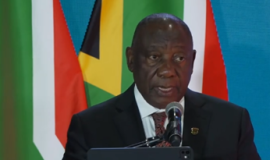
President Cyril Ramaphosa says South Africa’s massive infrastructure investment programme must be used as a catalyst to rebuild the country’s industrial base, expand manufacturing capacity, develop skills and create jobs.
Addressing the Steel and Engineering Industries Federation of Southern Africa (SEIFSA) Presidential Business Breakfast at the Radisson Hotel OR Tambo on Thursday, the President said South Africa was entering one of the most important periods of infrastructure investment and economic reform since the advent of democracy.
“Our task is to ensure that this investment does more than build infrastructure. It must rebuild South African industry,” President Ramaphosa said.
He said every transmission line, railway, port and water system constructed should contribute to expanding the productive capacity of the economy.
“We must use this infrastructure programme to create factories, develop skills, strengthen supply chains, support new industrialists and create jobs,” he said.
The President highlighted the strategic importance of the metals, engineering and capital equipment industries, noting that SEIFSA’s more than 1 300 member companies manufacture equipment and components essential to mining, electricity, transport, manufacturing and other productive sectors.
He acknowledged, however, that manufacturers continue to operate under difficult conditions, including weak domestic demand, logistics constraints, high electricity costs, infrastructure bottlenecks and growing import competition.
Globally, fragile steel demand, excess steelmaking capacity, geopolitical tensions, supply chain disruptions and energy price volatility are adding to the pressures facing South African companies.
“Investment decisions are delayed. Margins are squeezed. Factories operate below capacity. And ultimately, jobs are placed at risk,” he said.
He warned that South Africa could not accept the continued erosion of its industrial base, describing manufacturing as fundamental to the country’s economic sovereignty.
“It generates skills. It drives innovation. It supports exports. It creates productive employment. And it sustains thousands of businesses throughout the economy,” he said.
Electricity reform
President Ramaphosa said government was working with business and labour to address structural constraints through reforms under Operation Vulindlela, which was established six years ago to accelerate reforms in electricity, logistics, water, telecommunications and the visa system.
He identified electricity reform as particularly important for the metals and engineering industries.
While the end of load shedding was a major achievement, he said electricity also needed to become more affordable, particularly for energy-intensive industries.
“Electricity must also be affordable,” the President said.
He noted that electricity tariffs had increased significantly faster than inflation over the past two decades, placing pressure on smelters and other energy-intensive operations.
He said the next phase of electricity reform would focus not only on security of supply but also on reducing the cost of electricity.
The South African Wholesale Electricity Market is expected to begin operating next year, creating a competitive electricity market where multiple generators will compete to supply electricity.
President Ramaphosa said competition, together with expanded transmission capacity and continued investment in new generation, should create a more efficient electricity system and place downward pressure on electricity costs.
He also announced that the Eskom Restructuring Task Team had been established to oversee the work required to establish a fully independent, state-owned transmission company.
The restructuring, he said, must minimise financial, operational and fiscal risks, strengthen energy security and contribute to reducing electricity costs, while safeguarding Eskom’s financial sustainability and ensuring workers are treated fairly.
Energy transition an industrial opportunity
President Ramaphosa said South Africa’s energy transition should also become an industrial transition.
“South Africa should not simply import the technologies required for the new energy economy. Where we have the capability, or can realistically develop it, we should manufacture them here,” he said.
He identified opportunities for domestic production of towers, transformers, cables, switchgear, structural steel and other electrical equipment, as well as opportunities in green metals, mineral beneficiation, battery manufacturing and green hydrogen.
The most immediate opportunity, he said, lies in expanding the country’s electricity transmission network.
South Africa needs around 14 000 kilometres of new transmission lines over the coming decade, together with major investment in substations and transformation capacity.
The President described this as the largest transmission expansion programme in the country’s history, saying it would create substantial demand for fabricated steel, conductors, cables, transformers, insulators, switchgear, substation equipment, engineering services and logistics.
“This should become one of the great industrial projects of our generation,” he said.
He said the programme should deliberately be used to rebuild South Africa’s existing capabilities in steel fabrication, electrical equipment, distribution transformers and power transformers.
“We should not find ourselves, ten years from now, with a vastly expanded transmission grid but a diminished domestic manufacturing industry,” President Ramaphosa said.
He added that the transmission programme should also serve as a national skills programme, creating opportunities for engineers, electricians, welders, boilermakers, toolmakers, technicians, designers, project managers and construction workers.
Logistics, ports and water
The President said similar opportunities existed through government’s reforms of freight logistics.
Multiple train operating companies are gaining access to the freight rail network, while the legislative and institutional framework for rail reform is being modernised.
Significant private investment will be required to restore locomotives, wagons, signalling systems, rail infrastructure and terminal capacity.
“South Africa once possessed formidable capabilities in railway engineering and railway equipment manufacturing. We must rebuild them,” he said.
He said the country should manufacture more locomotives, wagons, wheels, axles, signalling equipment and other components required by its railway system.
The same approach should apply to port infrastructure, with investment being directed towards cranes, handling equipment and terminal modernisation.
President Ramaphosa also highlighted opportunities arising from water sector reforms, noting that reliable industrial water supplies are essential to steelmaking, mining, manufacturing and virtually every productive sector.
Government has published the National Water Action Plan, while implementation is being coordinated through the National Water Crisis Committee.
The South African National Water Resources Infrastructure Agency is also being operationalised.
Government is investing approximately R24 billion a year through national grants in municipal water and sanitation infrastructure, with further investment being mobilised through public-private partnerships and new financing mechanisms.
This, the President said, would create demand for pipes, pumps, valves, treatment equipment, structural steel, engineering services and construction materials.
R1 trillion infrastructure programme
President Ramaphosa said government’s infrastructure programme amounted to around R1 trillion over the next three years and should be viewed as an industrial strategy rather than simply a construction programme.
“The central question is therefore: How much of the productive capacity required to deliver this infrastructure can we build in South Africa?” he asked.
He stressed that localisation should remain competitive and should not result in inefficiency or excessive prices.
“Localisation must be competitive. It must meet technical standards. It must deliver quality. And it must deliver on time,” he said.
However, where South African companies can produce competitively, public investment should provide the scale and certainty needed to encourage investment.
The President said industry had repeatedly raised concerns that manufacturers could not invest in new factories without visibility of future demand.
He said government therefore needed to improve the coordination and publication of its infrastructure pipeline so companies could anticipate procurement by government, State-owned enterprises and other public institutions over the next five, 10 and even 15 years.
“Predictability creates investment. Investment creates capacity. Capacity creates jobs,” President Cyril Ramaphosa said.
He said the Steel and Metal Fabrication Master Plan remained important and that government would continue working with industry and labour to address structural challenges across the steel value chain.
Steel industry a national priority
President Ramaphosa described steel as a strategic industry and said the future of the metals and engineering sector was inseparable from the future of South Africa’s steel industry.
“Without steel, there is no industrial economy. There are no transmission towers. There are no railway lines. There are no mines. There are no factories. There are no bridges, ports or major water infrastructure,” he said.
He said supporting a competitive and sustainable steel industry was therefore a national priority but stressed that support needed to go hand in hand with competitiveness.
The industry must invest in modern technology, improve productivity, reduce its carbon intensity, produce consistently to international standards and compete successfully in export markets.
Government would also seek to deepen domestic value chains when major equipment is imported through instruments such as the National Industrial Participation Programme and supplier development requirements.
These should generate local investment, technology transfer, research and development, supplier development, skills and export opportunities.
On trade, President Ramaphosa said South Africa could not be indifferent to unfair trade practices, while also recognising that downstream manufacturers relied on competitively priced inputs.
“Our trade policy must therefore strike a careful balance,” he said.
He said work by the International Trade Administration Commission on steel tariffs and rebates was intended to achieve that balance.
Skills and industrial development
The President stressed that government and industry must place skills development at the centre of infrastructure investment.
South Africa’s major industrial companies had historically trained artisans such as fitters and turners, electricians, boilermakers, welders, millwrights and toolmakers.
“We need to rebuild that training culture,” he said.
He proposed that every major infrastructure contract should consider not only the infrastructure delivered, but also the number of apprentices trained, artisans qualified, young engineers gaining experience and local suppliers developed.
“How many apprentices will be trained? How many artisans will qualify? How many young engineers will gain experience? How many local suppliers will be developed? How much new manufacturing capacity will remain in South Africa when the project is complete?” President Ramaphosa asked.
“That is how infrastructure investment becomes industrial development,” he said.
South Africa as an engineering hub for Africa
President Ramaphosa said the long-term future of South African manufacturing also depended on expanding exports.
He highlighted the opportunities presented by the African Continental Free Trade Area, which is creating a market of more than a billion people.
Across the continent, countries are investing in cities, railways, power stations, transmission networks, mines, factories, water systems and ports.
“They will require precisely the products and capabilities represented in this room. South Africa should aspire to become the engineering workshop of the African continent,” he said.
The country should export transformers, mining machinery, railway equipment, pumps, valves, fabricated steel, electrical equipment and engineering expertise, he said.
Government would continue supporting exporters through trade negotiations, export promotion, trade facilitation and industrial financing.
A new era of industrialisation
President Ramaphosa said South Africa should move beyond discussions about the decline of manufacturing and focus on its renewal.
“The opportunity is before us,” he said.
He said reforms in electricity, logistics and water were beginning to change the conditions under which the economy operates, while the infrastructure programme was creating a substantial pipeline of demand, the energy transition was opening new industries and the African Continental Free Trade Area was creating access to a vast continental market.
“We must bring these opportunities together into a new programme of industrialisation,” he said.
Government must provide certainty, remove constraints, coordinate infrastructure investment and use public procurement strategically and responsibly, while industry must invest, innovate, compete, transform and train.
Labour, he said, must remain a partner in building productive workplaces, developing skills and ensuring workers share in the benefits of industrial growth.
“If we do these things together, South Africa can once again become a country that makes things. A country that manufactures the equipment for its own development. A country that transforms its minerals into higher-value products.
“A country that exports machinery and engineering expertise to the world. And, most importantly, a country that creates millions of productive jobs for its people,” President Ramaphosa said.
He said South Africa already had the minerals, infrastructure base, engineering capability, industrial experience and entrepreneurs needed to realise this ambition, as well as a generation of young South Africans eager for skills and opportunity.
“What is required now is that we bring these strengths together. Let us build the transmission lines. Let us rebuild the railways. Let us modernise our ports. Let us secure our water infrastructure. But as we build them, let us also rebuild South African industry,” he said.
The President emphasised that the infrastructure programme should become the foundation of a new era of industrialisation, with South Africa producing and exporting more while creating the jobs, industries and capabilities needed to sustain the economy for generations.
“I am confident that, working together, we can build an industrial economy worthy of South Africa’s immense potential,” he said. – SAnews.gov.za


