


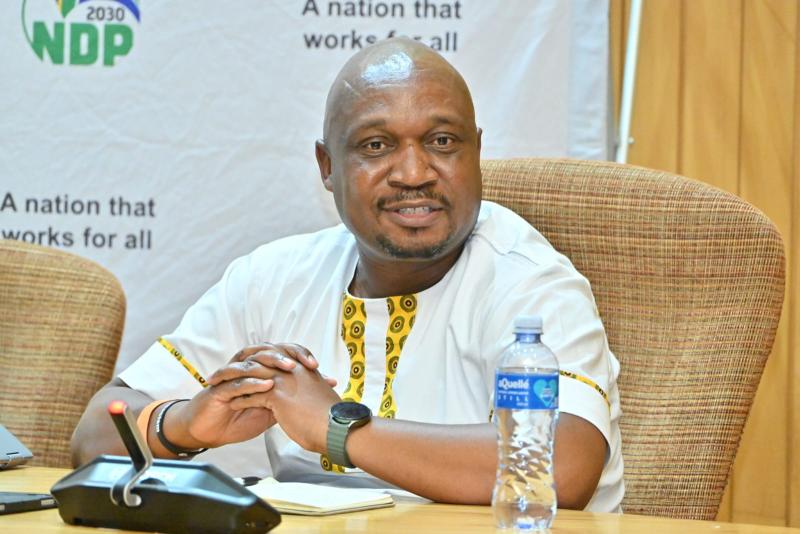
National Heritage Council Programmes Manager Amos Mulaudzi has urged South Africans to use indigenous languages in their daily lives to help preserve culture and heritage, highlighting storytelling as a powerful tool in this effort.
While acknowledging technological advances, Mulaudzi said people must return to basics and respect the sacred nature of traditions.
He highlighted the need to transform South Africa’s heritage landscape by reconnecting communities with oral traditions, storytelling and indigenous knowledge, while critically contextualising historical narratives for today's society.
“It’s a simple thing that people have forgotten: using our languages. We still have to go back to sitting around the fires and listening to stories that educate us about life in general.
“As much as we have digital technology, it doesn’t mean we can forget who we are as people. We therefore have to adapt our indigenous knowledge systems so that we draw on indigenous knowledge in our innovation and creativity,” Mulaudzi said on Wednesday in Pretoria.
He made the remarks during a dialogue titled: “South Africa’s Heritage as a Key Milestone: Institutions and Society,” hosted by the Government Communication and Information System (GCIS), in partnership with the University of South Africa (UNISA).
The dialogue forms part of Heritage Month commemorations and reflected on heritage as a living resource that strengthens social cohesion, democratic participation, identity and nation-building.
It brought together representatives from government, academia, heritage institutions, community media, civil society, youth and cultural formations to explore the role of institutions and society in preserving public memory and advancing a shared national future.
Heritage Day is observed annually on 24 September. This year, Heritage Month was commemorated under the theme “Celebrating Our Living Heritage: Strengthening the Ties That Bind Us”.
Mulaudzi said South Africa’s heritage should be taught in the school curriculum because it is central to the country’s identity.
“It’s about who we are. It’s good that technology makes it easier for us to reach communities we would not normally reach. But we also have to use technology responsibly. There are things within living traditions that are sacred.
“There are things within our living traditions that are restricted. So, as and when we share this knowledge and information, it is always important to engage elders and seek their consent.
“The beauty of our living heritage lies in its sacredness. Elders should therefore be involved in decisions about heritage management. They are there to be honoured and acknowledged,” he said.
UNISA Professor Nokuthula Hlabangane encouraged a critical examination of inherited knowledge and greater recognition of overlooked knowledge systems.
She questioned the role of universities in representing heritage, asking: “So, to the question, is the university presenting heritage? Indeed, it is. Indeed, it is. The question is: Whose heritage? Whose heritage?”
The Professor said this question was particularly important when considering the hidden curriculum - the knowledge, values, and assumptions communicated through institutions, sometimes without being explicitly taught.
“I’m writing a paper on the hidden curriculum - the things that we get taught; the things that we teach without even realising that we are being taught, without realising that we are even teaching,” she said.
Hlabangane said communities possess knowledge that has historically been passed down through generations and questioned why mainstream understanding often excludes it.
Kara Heritage Institute Executive Director, Dr Mathole Motshekga, highlighted the importance of understanding who we are, where we come from, and the heritage that shapes our identity, while recognising Africa’s place and contribution in the world.
“We are an African people on the southern tip of the continent. We are not an outpost of Arabia, or Europe, or Asia. We must teach African spirituality - African spirituality as an exposition of where they really, of course, come from,” Motshekga said.
This year’s Heritage Month commemoration marks 31 years since Heritage Day was first celebrated in post-apartheid South Africa.
Heritage Day is a key milestone in South Africa’s freedom calendar. It affirms the right of all communities to celebrate, practise, preserve, and share their diverse cultural heritage while contributing to a united and inclusive society.
It serves as an important platform for highlighting the people, practices, knowledge, and traditions that continue to shape South Africa’s cultural identity. It is an opportunity to celebrate what connects us, acknowledge the richness of our differences, and ensure that living heritage remains relevant and accessible to future generations. -SAnews.gov.za


