


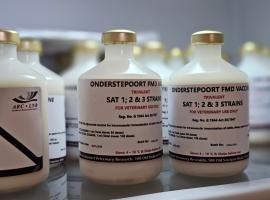
South Africa’s fight against Foot and Mouth Disease (FMD) has received a boost with the first batch of locally produced vaccines in over 20 years set to reach farmers soon.
This as the country has resumed local FMD vaccine production.
“This milestone signals a shift from reactionary disease chasing to a proactive, science led war on FMD. The goal is to reclaim South Africa’s FMD free status from the World Organisation for Animal Health (WOAH), using locally produced vaccines through collaboration between government, the Agricultural Research Council (ARC), and Onderstepoort Biological Products (OBP), “the Ministry of Agriculture said.
This as the Minister of Agriculture, John Steenhuisen, visited the ARC Onderstepoort Veterinary Research facility to witness the finalisation of the first batch of locally produced Foot and Mouth Disease vaccines on Friday. President and CEO of the ARC, Dr Litha Magingxa, handed over the first batch of locally produced vaccines.
The visit followed the completion and registration of the vaccines by ARC scientists and technical experts, developed using local infrastructure and expertise.
The vaccine is registered as a stock remedy under Act 36 of 1947 and complies with the required quality, safety, and efficacy standards.
Minister Steenhuisen acknowledged the severe emotional and financial toll the current FMD outbreaks have taken on the agricultural community.
“To our farmers who have watched their livelihoods disappear before their eyes, I hear you, and I feel the weight of this hardship with you. This has been a long, exhausting road, but I want you to know that help is not just coming; it is here.
“My Department and I will stop at nothing to ensure this disease is completely eradicated from our farms and communities. While the path to full recovery will take time, specifically through our focused ten-year strategy, we are finally moving from defence to offence. Please do not lose faith; we are building a system that will protect your herds for generations to come,” he said.
Ageing technology and infrastructure, which were non-compliant with international Good Manufacturing Practice standards, led to South Africa ceasing production of the vaccine in 2005.
However, after nearly two decades of research and modernisation, the ARC has successfully produced its first 12 900 doses using modern bioreactor technology.
The breakthrough involved identifying circulating regional strains and ensuring the vaccines provide high potency, long-lasting immunity that meets strict international biosafety standards.
Between 2010 and 2018, the ARC started research within the existing facility, with the objective to:
1. Identify new candidate vaccine strains appropriate for use within the Southern African Development Community (SADC) region.
2. Adapt the strains to in vitro cultivation in bioreactors, in large quantities, to improve product yields compared to previous production techniques.
3. Determine the strains’ capacity to elicit protective immunity, both immunologically and clinically.
4. Determine the potency of the vaccine and the strength and longevity of immunity, which informs the vaccination schedule in the field.
The process was “very intensive” and required compliance with strict biosafety and biosecurity, safety, and good manufacturing practices, as well as regulatory compliance in terms of the Fertilizers, Farm Feeds, Agricultural Remedies and Stock Remedies Act, 1947 (Act No. 36 of 1947).
“The 12 900 doses were produced at a pilot scale as proof of production concept for the new virus strains and production technology developed,” said the department.
Distribution
The initial distribution of this batch is as follows:
Free State (2 300 doses),
Eastern Cape (2 600 doses),
North West (2 000 doses),
Gauteng (2 000 doses),
Limpopo (2 000 doses) and
Mpumalanga (2 000 doses).
From March 2026, the ARC will be able to supply 20 000 doses per week of its monovalent SAT 1, SAT 2, or SAT 3 vaccine, and subsequently 200 000 monovalent doses per week from 2027.
Securing the vaccine pipeline
To bridge the gap while local production scales up, the Department of Agriculture has clarified its procurement strategy to ensure a steady supply.
“From the outset, it is important to clarify misinformation regarding vaccine imports by private companies. Minister Steenhuisen and the Department confirm they have no objection to the use of designated agents, such as Design Biologix for Argentina’s Biogénesis Bagó and Dunevax for Turkey’s Dollvet.
“The priority is the consistent arrival of vaccines, not the specific procurement channel. The Department maintains that claims proposing a vaccine free for all are short sighted and reckless and fly in the face of established international and local precedent for disease control.”
The Ministry added that the department has already seen the serious risks posed by illegally imported vaccines in KwaZulu-Natal.
READ | Serious risks posed by unregulated vaccine use
“It should again be stressed that the Department welcomes assistance from the private sector in eradicating this disease. The private sector, industry bodies, and others have been included at every step, from the initial FMD lekgotla to the Ministerial Task Team and the FMD Industry Coordination Council.”
The department has furthermore committed to working with private veterinarians and animal health technicians as the vaccine rollout proceeds.
In order to regain FMD-free status with vaccination from the World Organisation for Animal Health, South Africa must prove there has been no virus transmission for at least twelve months. It said that this requires a strictly controlled vaccination rollout, official surveillance, strict movement controls, and systematic vaccination coverage that can be documented and verified.
“Without centralised monitoring and state-led control over the process, the country will fail to achieve this goal, causing long-term damage to agricultural exports and negating the entire vaccination strategy.”
Through the Botswana Vaccine Institute (BVI), South Africa has already acquired, monitored, and administered two million vaccines to date.
The BVI has confirmed the supply of 700 000 doses of FMD vaccine by the end of February 2026. This will be followed by monthly supplies of 700 000 doses in April, May, and June.
Biogénesis Bagó of Argentina will soon supply one million doses, with a further five million doses expected in March 2026.
The 1.5 million-dose Dollvet vaccine from Turkey is expected to arrive in the country in the third week of February 2026, followed by a second supply of five million doses in March 2026.
Disaster Updates and Scientific Rigor In line with WOAH agreements for FMD reference laboratories, local FMD strains have been sent to the Pirbright Institute in the United Kingdom for matching against circulating viruses.
Additionally, the Department has finalised a memorandum to declare a National State of Disaster, which will be tabled soon in Cabinet.
“This will unlock emergency funding for mass vaccination across affected provinces,” said the Ministry. -SAnews.gov.za


