


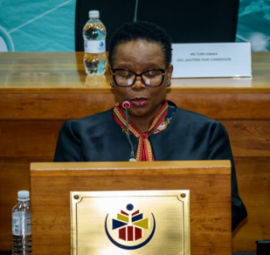
Artificial intelligence (AI) must be used to expand opportunities for women beyond newsrooms, universities and technology companies, particularly women in rural communities who often face barriers to accessing information, skills and digital opportunities.
This was the call from Government Communication and Information System (GCIS) Chief Director: Products and Platforms, Zanele Mngadi, during the third annual Women in Media and Communications Panel Discussion hosted in partnership by the GCIS and Tshwane University of Technology (TUT) on Wednesday.
Held during Women's Month under the theme “Coded for Equality: Women, AI and the New Media Landscape”, the discussion brought together government, academia, media and industry representatives to examine women's representation and influence as artificial intelligence increasingly shapes the way information is created, distributed and consumed.
Mngadi said the conversation around AI should extend beyond its impact on women's careers to consider how the technology could be used to improve the lives of women who remain underserved by the digital economy.
“How can we use these tools to make information more accessible to a woman in a rural village – in her own language and through a platform she can access?
“How can we connect her more effectively to information about healthcare, education, agricultural support, business opportunities, government services or protection from gender-based violence?” Mngadi asked.
She said technology would only become more meaningful when it helped ensure that the voices and experiences of women, including those in rural areas, were represented in the information environment.
“And how do we ensure that her voice and lived experience are present in the stories we tell and the information environment we are building? That, for me, is where technology becomes more meaningful,” she said.
Mngadi said women journalists and communicators were well placed to use AI to expand access to credible information.
“In the hands of women journalists and communicators, AI can become a powerful tool for inclusion, enabling us to deliver credible and useful information further, faster, in more languages and in forms that speak to the realities of women wherever they live,” she said.
From representation to influence
The event's keynote speaker, Gauteng Film Commission CEO Tumi Lebaka, challenged women to look beyond simply securing a place in the technology and media sectors, arguing that meaningful transformation requires women to have influence over resources, decisions and intellectual property.
“Equality cannot depend on women becoming better at surviving unequal systems. And we therefore have to participate in redesigning systems themselves,” Lebaka said.
She warned that existing inequalities could simply be reproduced through new technologies if women were not involved in shaping AI.
“So, if we are to train tomorrow's technology on yesterday's world, we could teach the future yesterday's prejudices,” she said.
Lebaka said women needed to move beyond being users of AI and become developers, researchers, policymakers, regulators, entrepreneurs, investors and owners.
She drew a parallel between the historic struggle for representation in media and the emerging need for women to enter what she described as the “algorithm room”.
“Now there is another room we need to enter. That room is the algorithm room, because increasingly the algorithm is becoming another lens,” she said.
Lebaka said algorithms increasingly influence what content people see, which voices are amplified and even perceptions of beauty, leadership and success.
Citing research presented during her keynote, she said women account for only 22% of AI professionals globally, highlighting the need for greater female participation in the development of technology.
She said representation alone was insufficient if women did not have access to the economic opportunities created by their participation.
“Representation without economic participation is an incomplete transformation. Because as women, we are fine getting a seat at the table, but now it's time for ownership,” Lebaka said.
Building the skills to shape AI
The panel discussion further examined the skills women need to participate meaningfully in the changing media and technology landscape.
TUT Multimedia Journalism Lecturer, Online Editor and Researche, Sholain Govender-Bateman said coding should be introduced to students from first year, including those studying humanities.
She said journalists needed sufficient technical understanding to use AI tools effectively in a South African context and to ensure that the data informing those tools reflected the experiences of local communities.
“Firstly, we need to speak about on first year level, introducing basic coding, even if you are a humanities student,” Govender-Bateman said.
She said coding skills would help journalists tell stories about women and communities in ways that promote equality.
Meanwhile, Business leader and Communication and Advertising specialist Mathe Okaba urged women to be more deliberate about entering spaces where decisions about AI and technology are being made.
“Let's stop being left behind as women. Let's put up our hands and step up and be part of it, influence it…Don't be afraid to get your hands dirty. Be passionate when you get in there. I think in shaping the media landscape, we need to just put up our hands and say, I am there and you'll be counted,” Okaba said.
The panel also featured Councillor Liaison and Stakeholder Relations at the City of Tshwane Makhanani Ngobeni, seasoned SABC journalist and reporter Patricia Visagie, and Professor of Marketing, Communications and Leadership Prof Vinessa Naidoo.
The discussion covered the opportunities and risks presented by AI in journalism and communications, including representation, bias, ethics, inclusivity, skills development and career pathways.
Bridging the digital divide
Mngadi said the responsibility to ensure women benefit from technological advances also extended to government.
Through SA Connect, government is working to expand broadband connectivity and community Wi-Fi, particularly in underserved communities, while the National Digital and Future Skills Strategy is aimed at equipping South Africans with skills for participation in the digital economy.
She said women must have a voice at every level of the technology ecosystem.
“Technology is not automatically neutral. AI learns from data generated by societies with their own histories, inequalities and biases. If those biases are embedded in the data, technology can reproduce and amplify them,” Mngadi said.
She also highlighted the growing threat posed by AI-generated misinformation and disinformation, saying credibility and public trust were becoming increasingly important as convincing fake text, images, audio and video become easier to produce.
The GCIS, she said, is strengthening its response, including work towards a government fact-checking capability to proactively debunk deepfakes and false information.
The event formed part of a broader GCIS-TUT partnership aimed at bringing government, academia and the media together to prepare young professionals for a rapidly changing communications environment.
Mngadi said the success of this transformation should ultimately be measured by whether women's growing participation in technology and media translates into meaningful improvements in the lives of women beyond professional spaces.
“Our measure of progress cannot simply be how many women are present in our newsrooms, communications departments, universities or technology companies.
“It must also be how much influence women have over where these industries are going, and whether that influence improves the lives of women beyond those rooms,” she said.
As South Africa marks 70 years since the historic Women's March of 1956, Mngadi said the struggle for equality must now extend into the digital age.
“Women cannot wait for the digital revolution to deliver equality. We must help shape it and use our access to technology to open doors for other women. Our challenge is to ensure that the glass ceiling of yesterday does not become the algorithm of tomorrow,” she said. – SAnews.gov.za


