


By Dikeledi Molobela
New York, USA — New York is beginning to look less like the city that never sleeps and more like the city where the world converges to talk.
Around the United Nations Headquarters in Manhattan, the city’s familiar rhythm has given way to the unmistakable buzz of the UN 2026 High-Level Week. Official vehicles weave through the streets; security has been stepped up; police officers are stationed around key areas, while diplomats, government officials, journalists and delegations move steadily through the heart of the city.
For a few days, this corner of Manhattan becomes a meeting point for the world – a place where global issues take centre stage and conversations that reach far beyond New York unfold behind the familiar skyline.
The flags of nations represented at the United Nations provide a fitting backdrop to a week in which the world’s attention turns to New York, as countries prepare to set out their positions on some of the most pressing challenges confronting the international community.
Inside the UN complex, preparations are underway for the 81st session of the General Assembly, whose General Debate begins on Tuesday and runs through 28 September.
Nearly every major global question is on the table, from peace and security and climate change, to development, inequality, artificial intelligence, global health and the future of multilateralism.
The UN has described the 2026 High-Level Week as an opportunity to advance collective action for peace, dignity and equality, under the theme: “Restoring trust, managing transformation: A United Nations that delivers for all".
For South Africa, however, the week is about more than occupying a seat in the General Assembly.
The country is arriving in New York with a defined agenda aimed at advancing reform of the global system, strengthening Africa’s voice in international decision-making and placing inequality, development and global governance firmly on the agenda.
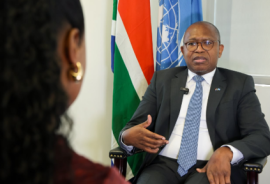
South Africa’s Permanent Representative to the United Nations in New York, Ambassador Mxolisi Sizo Nkosi, says UNGA81 provides an important opportunity to push forward the country’s foreign policy priorities.
“UNGA81 presents a number of opportunities for South Africa to advance its foreign policy agenda, flowing from the G20 summit that we hosted in Johannesburg last year,” Nkosi told SANews.
Among South Africa’s key priorities will be the launch of an initiative aimed at tackling one of the defining challenges facing countries across the world - inequality.
Nkosi said South Africa, together with Norway, Spain and Brazil, will host an event to launch the International Panel on Inequality, with the objective of building support among UN Member States for measures to address inequality within and between countries.
“We see what the drivers of this inequality are. It's impacting a number of countries, generally as a result of external shocks,” Nkosi said.
He pointed to the COVID-19 pandemic, the war in Ukraine and disruptions to food and energy supplies as examples of external shocks that can deepen existing inequalities.
The initiative will seek an endorsement of its vision statement before moving towards a proposed General Assembly resolution establishing the International Panel on Inequality.
The International Panel on Inequality event is scheduled for 23 September and will bring together governments and international organisations around the proposed initiative.
For Nkosi, securing support for the initiative would be one of the clearest measures of South Africa’s success at UNGA81.
“Our big priority here is to get support for our vision statement on the international panel on inequality. If we can get endorsement of our vision statement, that will be a big achievement for South Africa because that will launch us into the next phase, which will be to get a resolution of the General Assembly, and that will be a very big achievement for South Africa's foreign policy,” the Ambassador told SAnews.
Addressing inequality, however, will be only one part of South Africa’s broader objectives. Nkosi said AI governance has emerged as an increasingly important issue, while impressed on the importance of putting in place guardrails to guide its development and practical use.
“It's also important that a statement should come out of this General Assembly committing the international community to the development of a framework for the global governance of artificial intelligence.
“These will be apex priorities and outcomes that will constitute elements of a successful 81st session of the UNGA,” Nkosi said.
International Relations and Cooperation Minister Ronald Lamola is leading the South African delegation and is scheduled to address the General Debate, where the country will outline its positions on international peace and security, the global economy, climate change, artificial intelligence and reform of the multilateral system.
South Africa will also use the week to advance its longstanding call for reform of the United Nations, including reform of the Security Council to give Africa a more meaningful voice in global decision-making.
The issue comes as the UN itself undergoes a major reform process, while countries also prepare for the selection of a new Secretary-General following the end of António Guterres’s term at the end of 2026.
The UN’s 81st session is unfolding at a moment of institutional transition, alongside major geopolitical and economic pressures. The General Assembly’s official programme includes high-level meetings on the right to development, sea-level rise, pandemic preparedness and the 25th anniversary of the Durban Declaration and Programme of Action.
Nkosi said these issues are interconnected within South Africa’s foreign policy.
“South Africa's foreign policy is predicated on the promotion of peace and security. What we are doing here is aligned with our foreign policy. Other pillars of our foreign policy are around the promotion of respect for human rights, and the narrowing of the gap between the developed and developing countries,” he said.
South Africa will also seek to reinforce its position on climate change and a just transition, while the 25th anniversary of the Durban Declaration and Programme of Action will provide another important moment for the country.
Nkosi said South Africa regards itself as a custodian of the Durban Declaration and Programme of Action following the 2001 World Conference against Racism held in Durban.
As New York prepares for the hosting of world leaders and senior officials, South Africa’s delegation will enter the week seeking to turn broad diplomatic principles into concrete multilateral action.
For a city accustomed to the movement of millions of people every day, New York feels different during UN High-Level Week.
The security presence is more visible. The streets around the United Nations Headquarters are more tightly controlled. Diplomatic vehicles stream through the area, while officials, journalists and delegates move with a heightened sense of purpose.
For a few days, a small stretch of Manhattan becomes a stage for conversations that reach far beyond New York, drawing the world’s diplomatic attention into a few blocks around the UN.
For South Africa, it is an opportunity to ensure that its voice – and the priorities of Africa and the wider Global South it represents – remain firmly part of that conversation. – SAnews.gov.za


