


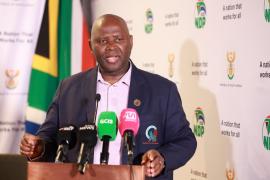
Chairperson of the Public Service Commission (PSC), Professor Somadoda Fikeni, has welcomed President Cyril Ramaphosa’s assent to the Public Service Commission Bill, which strengthens the Commission’s role in promoting effective and efficient public administration and professional ethics in the public service.
The bill is now known as the Public Service Commission Act. It is aimed, among other things, at strengthening the Commission’s independence as a constitutional institution and extending its mandate to include local government and public entities.
During a media briefing in Pretoria on Sunday, Fikeni highlighted the importance of the PSC, noting that a weak public service and administration will – even in the face of good policies – lead to “governance failures; it leads to poor service delivery, it allows for crime and corruption to thrive.”
“It makes investment difficult; the economy doesn't grow; it makes the country vulnerable to the world, because the close to 1.9 million public servants are the ones on the ground, and the Public Service Commission is that institution...which is there as an oversight body, which is there to ensure effective and efficient public administration.
“It is for that reason that we celebrate, finally, that Public Service Commission, like other Chapter 9 institutions...will have its own independent secretariat. All along, it was dependent on a secretariat which was created as a government department, and now it will finally be an institution that is independent,” the Chairperson said.
A major provision of the Act expands the PSC’s mandate to cover local government, state-owned companies and state entities, while also empowering it to conduct investigations on its own accord.
“The genius in that is that most of these entities, the shareholder is just a Minister, and the person who signs and appoints the Chairperson and the members of the board or council is generally the Minister. Yes, in some instances you may have some process.
“So, when you say there is some governance failure, the Minister investigates; you are saying the Minister investigates the people they appointed. But this time, PSC is empowered to have its own accord investigation without having to depend on the shareholder.
“But of course, we will work with all the institutions concerned, we’ll do the stakeholder engagement, we will work, we’ve been consulting with SALGA [South African Local Government Association], we’ve been consulting with the Minister of local government and the department itself,” Fikeni said.
A new approach
Fikeni acknowledged a period of decline, adding that the reforms now underway represent a course correction.
“[At] some point, the country seemed to drop the ball. Hence, the patrimonial system comes up: patronage, where loyalty instead of capability, instead of competence, became the measuring stick for who to appoint, where the political-administrative interface became murky. Hence, we had concepts such as state capture and corruption on an industrial scale
“But now, in the season we’re in, it's where you have started seeing a number of reforms coming in. Professionalisation framework, which was approved by cabinet in October 2022. You now have the Public Administration Management Act. You now have the Public Service Amendment Act. You now have the work towards whistleblower protection, which is underway. You now have the white paper on local government.
“So that whole basket is an effort to redeem ourselves, to move away from the detour we’ve taken back into the highway where we ought to make sure that the state and the public service can serve our people. And it is not only able to solve the problems as we have seen them, but also to anticipate the new key driving forces that will shape the public service of the future,” Fikeni noted.
The PSC will now embark on an implementation plan for the Act under the following parameters:
- The Act provides for a phased-in approach to this confirmed mandate. In phase one, the Commission's confirmed mandate over municipalities and public entities/enterprises is pended for a 12-month period. This will allow the Commission time to implement certain operational requirements in anticipation of the mandate. The Act furthermore provides that the full implementation of this confirmed mandate must be completed within three years after the expiry of the initial 12-month pended period.
- For PSC employees, the new Act ensures continuity, protection and fairness throughout the transition. All current PSC employees automatically become employees of the new Secretariat, with no break in service or interruption to employment. A joint employer-union task team will be established to assist with the placement of employees as part of the consultation processes for the PSC Secretariat migration of staff and function shift.
- Existing collective agreements and performance agreements will continue to apply as if concluded under the new system. Importantly, employees retain the right to opt out of moving to the Secretariat within 30 days, and those who choose not to move are safeguarded, with their salaries and conditions preserved until they are placed elsewhere in the public service or seconded to the Commission. A joint task team of employer and union representatives will oversee the migration process, while the PSC Bargaining Forum remains recognised as the collective bargaining structure.
- The expansion of the PSC’s mandate to municipalities and public entities/enterprises will be phased in over 12 months, ensuring gradual and well-resourced implementation. In essence, no employee will lose their job, salary, benefits, union rights or continuity of service because of this transition, which has been designed to guarantee a smooth and protected transfer with full consultation and safeguards.
“Let’s just try to focus on working together on how we make sure that the issues of statecraft, issues of accountability, and the oversight ecosystem are in place.
“We will now be given 12 months to start consulting, to start helping with unfolding, to meet with treasury, to say we have costed this particular Act. We need resources now to make it happen. But if there are no resources, it’s a Rolls-Royce without an engine,” Fikeni concluded. – SAnews.gov.za


