


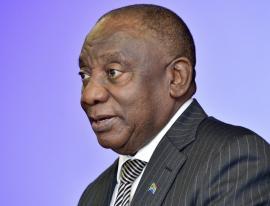
President Cyril Ramaphosa has hailed Toyota South Africa Motors' R10.4 billion investment in the production of the ninth-generation Hilux as a strong vote of confidence in the country's economy, saying it demonstrates South Africa's ability to convert investment commitments into jobs, industrial growth, and exports.
In a virtual address during the official line-off launch of the Toyota ninth-generation Hilux at the company's Prospecton plant in eThekwini on Thursday, the President said the milestone represented far more than the launch of a new vehicle.
“Today is about much more than the launch of a new vehicle. It is about confidence in South Africa. It is about the enduring value of long-term investment.
“It is about the strength of South African workers, engineers, technicians, and entrepreneurs. And it is about our shared determination to build an economy that produces, innovates, exports, and creates jobs,” the President said.
He added that the Hilux has become part of South Africa's story over the past five decades, and although it carried one of the world's most respected automotive brands, it was proudly regarded as a South African vehicle because it is "designed for our conditions, built by South African hands and exported from South African shores."
As South Africa marks National Science month, the launch of Toyota's new-generation hybrid vehicle highlights the growing role of science, technology and innovation in modern manufacturing in the country.
The President said Toyota's investment reflected exactly the type of investment South Africa was seeking to attract.
“The R10.4 billion investment in the new-generation Hilux programme demonstrates precisely the type of investment that South Africa seeks to attract,” he said.
The President said the real value of the investment was not in machinery or buildings but in the opportunities it creates for workers, suppliers, and young people entering the labour market.
“Its true value lies in the opportunities it creates. It lies in the thousands of South Africans whose livelihoods depend on this plant. It lies in the workers whose skills continue to grow. It lies in the supplier companies that have expanded their production. It lies in the young people who will find employment because businesses such as Toyota continue to invest in our economy.
“This is what inclusive industrial development looks like,” the President said.
President Ramaphosa said the launch also showed that South Africa was delivering on investment commitments made to investors.
“Today's occasion is powerful evidence that South Africa can convert investment commitments into tangible economic outcomes. It is also a reminder of the powerful multiplier effect of industrial investment,” he said.
He noted that about one-third of Toyota's investment had been directed towards strengthening local supplier capacity and tooling, while suppliers themselves had invested an additional R2 billion to expand localisation.
“That is how resilient industrial ecosystems are built. That is how domestic manufacturing capabilities deepen. That is how small and medium enterprises grow. And that is how sustainable economic development is achieved,” the President said.
Importance of SA’s automotive sector
According to the President, the automotive industry remains one of the pillars of South Africa's industrial economy, contributing around 5% of gross domestic product, supporting more than 115,000 direct manufacturing jobs, and over half a million jobs across the value chain.
He said the government was committed to ensuring the country remained globally competitive as the automotive sector transitioned towards cleaner mobility and new technologies.
“We are strengthening incentives for component manufacturing. We are supporting battery value chain development. We are promoting research, innovation, and skills development in new-energy vehicles. Above all, we are providing policy certainty that encourages investment, localisation and long-term growth,” he said.
President Ramaphosa also highlighted South Africa's critical mineral resources as a strategic advantage in the global shift towards future mobility.
“If we combine these natural resources with advanced manufacturing, local beneficiation, technological innovation, and world-class automotive production, South Africa can become a leading global hub for future mobility,” he said.
The President stressed that improving logistics remains essential to unlocking further industrial growth, welcoming improvements in freight rail and port performance.
“In the ten months to February this year, Transnet's vehicle terminals in Durban, Gqeberha, and East London handled more than 792,000 fully built vehicles - the highest productivity levels achieved in recent years,” the President said.
He said government will continue strengthening public-private partnerships in rail and ports to position South Africa as a globally competitive export platform.
Concluding his address, President Ramaphosa thanked Toyota South Africa Motors, government partners, organised labour, suppliers, and employees for contributing to the investment while paying tribute to the workers at the Prospecton plant.
“Every Hilux that leaves this production line carries with it your skill, your discipline, your craftsmanship, and your pride,” the President said.
He said the new-generation Hilux should carry a broader message to the world.
"That South Africa is open for business. That South Africans can compete with the very best in the world. – SAnews.gov.za


