


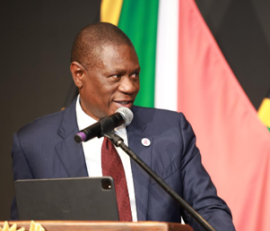
While South Africa has made progress in fighting tuberculosis (TB), as part of Government's priority to ensure access to effective healthcare, Deputy President Paul Mashtile has called for more action to rid the world of the disease.
"I fully agree with the Minister’s [Health Minister, Dr Aaron Motsoaledi] sentiment that ending tuberculosis (TB) in our lifetime is not impossible and that it requires solidarity, dedication, and commitment from all of us,” the Deputy President said on Thursday.
Addressing the closing plenary of the 9th SA TB Conference held at the Birchwood Hotel in Boksburg, Gauteng, Mashatile said that the country’s response to HIV and TB is a reminder that disjointed responses prolong epidemics, while collective action bends the curve of history.
“In the mid-2000s, specifically between 2006 and 2008, the country experienced a significant TB epidemic, further aggravated by a growing HIV crisis. Subsequently, in the year 2008, Government, researchers, and civil society resolved to end fragmentation and ‘work as one,’ recognising that TB could not be tackled in isolation from HIV, poverty, and systemic health challenges,” he said.
At that time, a shift began toward a more integrated response, leading to innovations like joint TB/HIV strategies and community-based care models, culminating in the National Strategic Plan for HIV, TB, and STIs.
He said that progress since the integration of TB/HIV strategies, community-driven care, and innovations in diagnostics and treatment proves that unity delivers results.
“Thus, the 2026 conference serves as a call for renewal and a call to rise together, across nations and sectors, to march towards a TB-free world. Yet even as we gather in unity, we must confront the stark truth that South Africa consistently ranks among the top eight countries globally for absolute TB incidence and stands first in the world when adjusted for population size.”
At the start of the conference on Monday, the magnitude of the country’s TB burden was laid out.
“Indeed, the picture does not look good. Nevertheless, as a country, we have gained momentum in our fight against TB by strengthening systems and embracing innovation and technology. As you have heard during the conference, this momentum is real,” he said.
He added that since 2015, South Africa has achieved a 61% reduction in TB incidence, surpassing the World Health Organization’s 2025 milestone ahead of time. Cases have declined from over half a million in 2015 to around 249,000 in 2024.
“This is proof of strong political commitment, scientific innovation, and the resilience of our communities. However, progress on TB mortality has been slow, with only a 17% drop since 2015, far short of the 50% target. This disparity serves as a harsh reminder that incidence reduction alone is insufficient to achieve triumph.”
The Deputy President stressed that lives must be saved, households must be protected, and dignity must be restored.
“South Africa’s response to TB continues to evolve with purpose and determination, underpinned by a strong multisectoral foundation led by SANAC, which coordinates efforts across government, civil society, the private sector, and other partners to strengthen prevention, diagnosis, treatment, and accountability mechanisms.”
He said that the next phase of the response must build on this momentum by leveraging strategic information, innovation, and integrated service delivery to break down barriers to access and ensure that interventions reach the most vulnerable in a timely and effective manner.
“This requires a deliberate shift towards a more people-centered approach that prioritises community engagement, strengthens systems resilience, and ensures that leadership at all levels is held accountable for delivering measurable impact in the drive to end TB as a public health threat.”
The conference highlighted the importance of strengthening prevention, closing diagnostic gaps, improving treatment outcomes, and addressing the social and economic drivers of TB. It has also reinforced the need for stronger accountability mechanisms so that commitments made translate into measurable impact at the community level.
Action
This as the country continues to demonstrate strong leadership in the fight against TB, driven by evidence-based interventions and data-driven responses.
One of the key milestones in the response has been the launch of the TB-data dashboard, which is accessible to the public. This platform enables more targeted interventions, strengthens data-driven decision-making, and fosters transparency by making critical information accessible to all stakeholders.
At the same time, South Africa remains at the forefront globally, among the first countries to adopt new and faster diagnostic technologies. This has significantly improved the ability to detect TB early and respond more effectively.
“We have also seen a rapid uptake of new tools and innovations across the TB programme. We have introduced service delivery innovations such as targeted universal TB testing, ensuring that high-risk groups, including TB contacts and people living with HIV, are routinely tested regardless of symptoms,” he said.
At the United Nations High-Level Meeting on TB, South Africa reaffirmed its pledge to implement TB vaccines as soon as they become available. This commitment said Deputy President Mashatile, is coupled with a recognition that ending TB requires addressing its root causes, including poverty, gender inequality, and the need for greater education on the TB epidemic.
“Together, these efforts reflect a comprehensive and forward-looking response, one that not only tackles the disease itself but also the conditions that allow it to persist.”
The “End TB Plan” by the Department of Health outlines priorities, activities, monitoring frameworks, stakeholder roles, and targets over a defined period.
It emphasises integration with HIV programmes, primary health care, and TB in the mines. It builds on the broader National Strategic Plan for HIV, TB, and STIs 2023 - 2028; the TB Recovery Plan; and the World Health Organization's global End TB Strategy.
The Deputy President also called on everyone to play their part in ending TB.
He said government leadership must provide policy direction and resources; health workers must be equipped with tools, training, and support; researchers must continue advancing scalable innovations and communities must remain active partners among others.-SAnews.gov.za


