


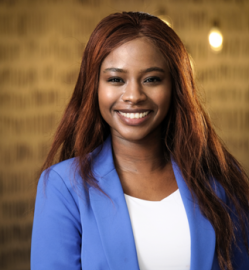
For Kelebogile Boleu, becoming a mother also meant becoming a student who had to learn a new language and how to advocate for a child whose experience of the world is different from her own.
“I don’t know what it is like to have a son who is not Deaf. He is my firstborn and the person who introduced me to parenting. It has been a remarkable calling and I am grateful to be trusted to be his parent,” Boleu, who is a lecturer at the University of the Free State (UFS), said.
Like most children, soon-to-be 11-year-old Nathanael is a handful.
“He has always been a handful. He is very confident and very courageous. I enjoy how independent he is now and how he can be placed in any room, and he will not feel small, but he will take up that space and make it his own,” the 36-year-old mother of two said in an interview with SAnews.
She described her son as competitive and kind, recalling an incident when one of his classmates came to school with a damaged bag and how her son came home, washed one of his older school bags and gave it to the classmate.
“To this day, he does not remind his friend or talk about it at home, and that is the character I enjoy most about him - helping quietly. I hope he does not change,” she says of her son who she affectionately refers to as “Nate.”
Boleu’s comments come as the country commemorates Deaf Awareness Month, in September. Deaf Awareness Month provides an opportunity to raise awareness of the rights, experiences and aspirations of Deaf people and to promote greater understanding of the importance of sign language.
According to the Pan South African Language Board (PanSALB), an estimated 600 000 people in the country are Deaf.
This year’s Deaf Awareness Month is marked under the theme “Declaring Deaf People’s Human Rights.”
Prior to the birth of Nate, neither Boleu nor her husband had a family member who was hard of hearing or Deaf. She had an “easy” pregnancy with nothing of his development being flagged.
“I flagged it when he was just older than two years. I took him to a speech therapist who gave us activities to do, which were mostly what we did at home: reading, puzzles, singing and so on. But it took two different opinions until I landed on a speech therapist who is also an audiologist.
"The very first assessment she highlighted that Nate did not have a speech problem but a hearing problem, and so the testing and hearing aids came until we landed on SASL [South African Sign Language],” she explained.
Hearts project
Boleu, who is a lecturer at the university’s Department of Criminology and a PhD student, said she tries her best to advocate for her children’s rights while empowering them to do the same.
She started the Hearts project, where parents can learn SASL and children can improve their reading skills.
“I write a lot of opinion pieces about Deaf education, and through that and recognising the barriers in education that exist for Deaf children, I began a project called Hearts where parents can learn SASL and children can improve their reading skills. My current academic work is centred around Deaf Rights; with for PhD, my research is titled: “Exploring procedural justice for Deaf people in the South African criminal justice system: From arrest to corrections,” she said.
Hearts was initially formed with Nate’s education and the related challenges in mind.
“But I also realised that for him, reading would be his most important route in terms of access, to be able to read and write, which is a global issue, which can be solved through intentional reading development opportunities.
“Speaking to other parents, I also realised we are different because Nate comes home to a family that signs, which creates an environment of being and relationship. I soon realised this is not the common experience. Many parents struggle to sign,” explained the 36-year-old.
Because many parents struggled to sign, it was difficult for them to help their children with homework. Maintaining meaningful conversations and relationships with Deaf children in their families also became difficult, leaving some Deaf children feeling isolated.
Boleu then consulted a friend and colleague in the South African Sign Language and Deaf Studies Department at UFS. She also consulted another friend and colleague in the university’s library department.
“I knew they were both passionate about their work, and they are practical in how they help communities. So, I asked them to help the community of Deaf learners and their parents; this is how the collaboration began.
“They both put their time and resources, and I gathered up the troops - all the parents and children I could find, who have remained consistent in attending and learning. The improvement in their signing has been remarkable. I am encouraged and inspired by the Hearts community,” she says of the initiative.
Nathanael began using SASL when he was six, learning to sign fluently in three months.
Boleu’s own introduction to SASL came during a year of her undergraduate studies. She admits that she is still “very intimidated” by first-language SASL speakers.
“I am still trying to catch up. My daughter and I, with a few close friends, had a few months of formal lessons. We now sign at home and learn as we go, through engaging with Nate. My daughter also attends the Hearts project, so through learning how to read in SASL, her signing has advanced far beyond mine. Our interaction with the Deaf community is really the biggest influence on all our SASL learning.”
She added that SASL is not an easy language to learn.
“My broader family and friends do their best, but it is not an easy language to learn, nor is it a widely used language, so learning should be intentional and practising is essential.”
Capacity building
President Cyril Ramaphosa signed into law the recognition of South African Sign Language as one of the country’s official languages in July 2023. Since that recognition, PanSALB has continued to support its practical implementation through awareness and capacity-building programmes.
These include basic SASL workshops for frontline service workers and for parents, siblings and families of Deaf children; the verification and authentication of SASL signs and dictionary vocabulary in consultation with diverse Deaf stakeholders; and ongoing advocacy during Deaf Awareness Month.
In a statement earlier this month, PanSALB said plans to establish a dedicated SASL National Lexicography Unit are also underway.
“These initiatives are intended to ensure that the official recognition of SASL results in meaningful access to information, public services and full participation in society for Deaf people,” said PanSALB.
Boleu said while the enactment of SASL as the country’s 12th official language is a start, more needs to be done.
“I think SASL being an official language is a start, the efforts towards interpreters and other accommodations in the effort to reduce barriers and allow access to services. However, there can be a better sense of inclusion, knowledge sharing, and practical applications of intentions. Policy and legislation need to be practical.”
Asked about what Nate would like the world to know about Deaf people, in her view, she said that they are people and barriers exist structurally, but these should not take from their livelihoods, their experiences of life and success.
“He would say that he and his friends are just kids, and they enjoy being able to take part in the same activities as other children. My son loves people and enjoys life, and would want everyone to see, experience, and know that.”
She added that a Deaf child is a blessing just as any child is.
“Deafness or any disability, though not an easy road, is a call to parent, a call to love, a call to be intentional about the life you’ve been called to guide and shape.”
Pride in Deaf culture
Boleu urged parents to learn SASL, adding that the Deaf community is proud of its culture.
“I encourage you to learn SASL. Create an environment for your child to feel a sense of belonging that begins at home in their household through their people. Learn and meet the Deaf community around you. Lean on their experiences and see your child through their brilliance, excellence and courage.
“The Deaf community is one that is proud of their culture, their language and welcoming to those who engage with them, accept them and allow their Deaf children to be who they are born to be,” she explained.
Asked about the lessons she’s learned in her journey of parenthood, Boleu said parents of Deaf children are no different from other parents.
“We are simply doing what parents have always done: loving intentionally, learning continuously and hoping fiercely. I love my son, and I cannot imagine him to be anyone but who he is. He has created a better human in me, as has my daughter,” she said. -SAnews.gov.za


