


Silicon Valley, California - South African business leaders have called for increased investment in local artificial intelligence (AI) innovation, with a proposal for a R100 million start-up fund to help entrepreneurs access the computing infrastructure needed to develop and scale homegrown AI solutions.
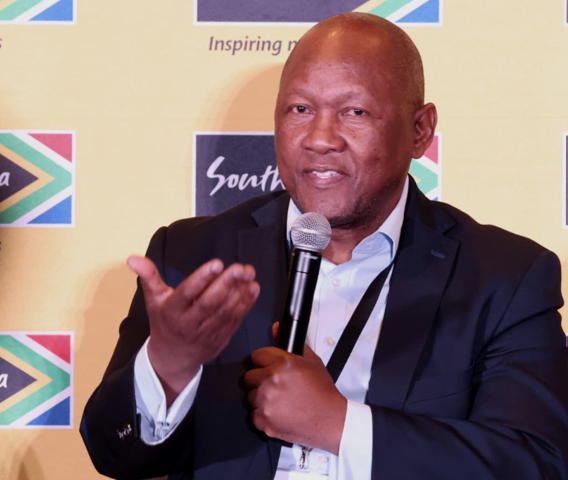
The proposal was tabled by Andile Ngcaba, Executive Chair and Founding Partner of Convergence Partners and Solcon Capital, during a working lunch between President Cyril Ramaphosa and South African micro, small and medium enterprises (MSMEs) on Wednesday.
The engagement, held on the margins of the 'South Africa and the AI Opportunity Conference' in Silicon Valley, provided an opportunity for business leaders accompanying the President to share their experiences, explore opportunities and outline practical ways of translating lessons from the technology hub into South Africa's own AI ambitions.
The business delegation is led by the Minister of Small Business Development, Stella Ndabeni.
Ngcaba proposed that development finance institutions (DFIs) and private sector partners collaborate to establish the R100 million fund, which would give start-ups access to computing power, one of the major cost barriers facing AI companies.
He committed to contributing 25% of the proposed fund and challenged other industry players to join the initiative.
“I want to challenge my colleagues from DFIs. I will put 25% into a R100 million start-up fund for you [President Ramaphosa] to launch during [the] State of the Nation Address. If the [DFIs] are able to come along with us, we will commit that here and now,” he said.
Drawing parallels with India's efforts to support its technology start-up ecosystem, Ngcaba said access to graphics processing units (GPUs), which are essential for AI development, is particularly expensive for emerging businesses.
“If you are an AI company, access to compute is one of the most expensive parts. This is what burns cash quickly. So, we suggest that we put in 25% of R100 million as a start. We can increase this, depending on consumption,” he said.
He said bringing together DFIs and private companies can help to make computing infrastructure more accessible to local entrepreneurs, enabling them to develop and commercialise their innovations.
Also emphasising the need to invest in local innovation was nuclear scientist and telecommunications entrepreneur Nomso Kana, who said South Africa already has the scientific expertise and entrepreneurial talent to develop its own AI solutions.
“... South Africa [has the] brain power. I know this is a learning excursion, but from what we have seen, we are not far off as a country,” she said.
Kana said her company has developed deep-learning systems, drawing on expertise from the nuclear industry, to develop telecommunications solutions. The company has also successfully raised funding for the work.
She called for increased financial support for the Department of Small Business Development [DSBD] to ensure that emerging businesses can access the capital needed to build their own AI models.
“There is now a need to increase the budget towards DSBD because there are a lot of companies that will mushroom. This small business development sector needs to be empowered with money for entrepreneurs to have bridge capital so that they can build their own AI models," Kana said, while expressing confidence in South Africa's abilities in achieving this goal.
A boost for service delivery
Meanwhile, CEO and co-founder of CLEVVA, Ryan Falkenberg, highlighted how AI could improve public service delivery, while creating opportunities for workers to focus on more meaningful interactions.
Falkenberg, whose company develops digital contact centres that automate conversations with citizens, said AI-powered agents could help address capacity constraints in public services.
Drawing on his company's experience from working with councils in the United Kingdom, Falkenberg said digital agents could assist citizens with routine enquiries, including account queries and service delivery issues.
This, he explained, would allow human contact centre agents to spend more time handling complex matters and building better relationships with citizens.
“I think AI doesn't have to destroy jobs. It can actually improve the whole experience,” he said.
In the healthcare sector, medical doctor and entrepreneur Yaseen Khan said AI could significantly strengthen the capacity of South Africa's healthcare workforce and improve health outcomes, while reducing costs.
Khan, the CEO of Essential Medical Guidance, said his company is developing AI infrastructure and platforms to support doctors, nurses, pharmacists and other healthcare professionals.
He highlighted the country's healthcare worker to patient ratio, which results in a strained system.
“If we superpower the health force, we can make a significant change to South Africa's healthcare outcomes and, more importantly, healthcare costs,” he said.
Serving through technology
Zanyiwe Nthatisi Asare, founder of Digitally Legal, highlighted the potential of AI to strengthen trust, unlock economic opportunities and facilitate crossborder business across the continent.
She said her work focuses on bringing global technology companies into African markets through market-entry strategies, regulatory guidance and data governance.
Asare said her participation in the Silicon Valley mission has reinforced her ambition to develop African AI solutions, create jobs and rebuild trust through shared economic opportunities.
She also emphasised the importance of ensuring that AI innovation is grounded in existing laws, with privacy, accountability and human oversight forming part of its development.
Asare challenged government to bring together technology platforms, regulators and an African partner country to establish a pilot project that South African MSMEs can help to develop and commercialise.
For Jon Kornik, CEO of Plentify, South Africa's clean energy resources could become an important competitive advantage as demand for AI computing infrastructure grows.
Kornik said his company was building what he described as Africa's largest virtual power plant, using solar and battery systems in hundreds of thousands of homes.
The company was also exploring the rollout of AI computing nodes in homes and businesses, allowing communities to participate in the growing AI infrastructure economy.
“The key takeaway for me was that South Africa has an enduring competitive advantage in AI. Once intelligence is commoditised, once chip prices come down, what's going to determine the price of AI is the price of energy. And we are fortunate to have an abundance of clean energy,” he said.
Meanwhile, Thabo Sephuma, representing the Nelson Mandela Foundation, called on South Africans to translate the inspiration gained from the Silicon Valley visit into tangible action.
Quoting former President Nelson Mandela, Sephuma said: “As Madiba said, it's always impossible until it's done.”
He said the delegation is ready to contribute towards advancing South Africa's technological ambitions.
“We're inspired, and I hope this inspiration should translate into action when we get home. So we are ready to get our hands dirty and really take South Africa to the next level,” he said.
President calls for practical action
Welcoming the business leaders, President Ramaphosa said the working lunch had been incorporated into the programme to allow government to engage more directly with entrepreneurs and hear their impressions of the Silicon Valley visit.
He thanked the business delegation for making time to participate in the mission, noting that their presence had added significant value to the visit.
The President said he was particularly encouraged by the participation of business leaders, who are already operating internationally, including in the United States.
He said South Africa needs to continue learning from leading technology economies and translate the lessons into practical initiatives that could be implemented back home.
“I want us to scour the world and see what best practice we can gather and go back home and implement some of the things that we are picking up,” President Ramaphosa said.
The President said the ultimate objective is to ensure that South Africa develops practical solutions and does not fall behind in the rapidly evolving technological landscape. – SAnews.gov.za


