


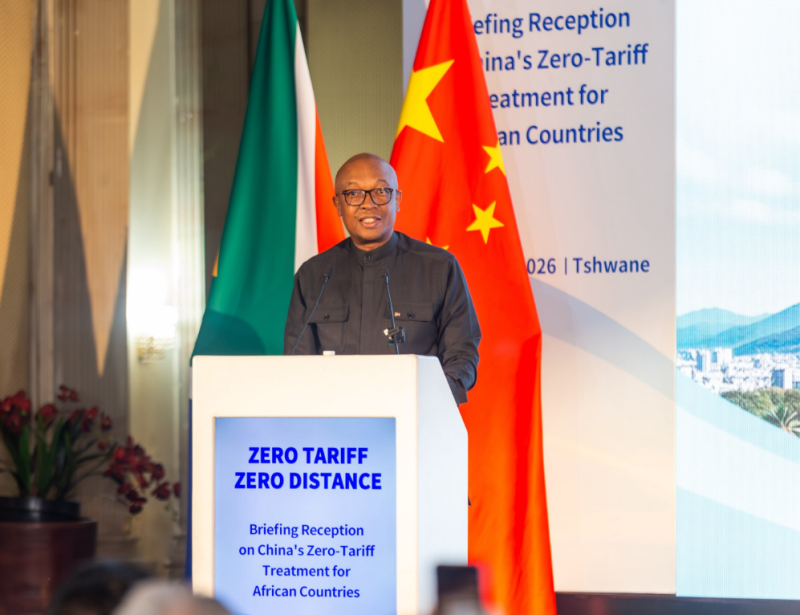
South Africa is working to turn China’s zero-tariff treatment for African countries into increased exports, local manufacturing and job creation.
Speaking at a briefing reception on China’s Zero-Tariff Treatment to African Countries, in Pretoria on Thursday, Trade, Industry and Competition Minister Parks Tau urged South African businesses to take advantage of duty-free access to the Chinese market, while government continues negotiations aimed at providing long-term certainty for exporters and protecting local industries.
“Let us move from interest to deals, and from deals to prosperity,” the Minister said.
China introduced the unilateral preference scheme, which provides duty-free market access for 100% of products, with the exception of 47 tariff lines subject to tariff-rate quotas, for the period from 1 May 2026 to 30 April 2028.
Tau said South African products that meet the applicable rules of origin can enter the Chinese market without customs duties.
Between 1 June and 31 August, the South African Revenue Service (SARS) issued 25 975 certificates of origin, while customs declarations increased by 199% year-on-year.
The Minister said South Africa had also developed a Top 100 value-added product portfolio for the Chinese market, covering sectors including agro-processing, beverages, chemicals and pharmaceuticals, cosmetics, machinery, medical equipment, fabricated metals, plastics and rubber, automotive products and other industrial capabilities.
The portfolio is intended to help direct export-promotion activities towards products with identified commercial opportunities.
Strengthening trade ties
China remains South Africa’s largest trading partner globally and an important source of investment.
Total bilateral trade between the two countries reached R642 billion in 2025, up from R483 billion in 2021. South African exports to China increased from R198 billion to R222 billion over the same period, while imports from China rose from R284 billion to R420 billion.
Chinese foreign direct investment stock in South Africa stood at R117 billion in 2024, with more than 200 Chinese companies having invested in the country. More than 25 South African companies have also invested in China.
Tau said the scale of the relationship made predictable trade rules and balanced trade essential.
“A relationship of this importance must rest on predictable rules and balanced trade. The zero-tariff treatment runs for two years, and we are not waiting for it to expire.”
In February, Tau and Chinese Minister Wang Wentao signed a framework agreement on economic partnership in Beijing. South Africa and China are now negotiating an Early Harvest Agreement through the Southern African Customs Union (SACU), with officials in Beijing this week working towards concluding the negotiations.
The proposed arrangement is intended to provide exporters with greater certainty beyond 2028, while including safeguards to protect South African industry and jobs.
“South Africa trades with all its partners. Diversifying our markets is how we protect South African jobs in an uncertain world. Predictable market access gives investors the confidence to build production in South Africa.
“That is what we want, not only more trade, but more factories, more processing and more jobs here at home,” the Minister said.
Expanding industrial cooperation
He also highlighted progress in industrial development, including investment in special economic zones, automotive manufacturing, electric vehicles and battery production.
On Tuesday, Tau visited the Fetakgomo-Tubatse Special Economic Zone, which is situated between the Lion and Samancor chrome smelters in Limpopo.
READ | Fetakgomo-Tubatse SEZ: A game-changer for Limpopo mining and jobs
He said the focus on the zone forms part of South Africa’s Industrial Development Strategy, which prioritises the reopening of smelters to support economic growth.
In the automotive sector, Chinese vehicle manufacturers are contributing to local manufacturing through partnerships and investment in South Africa’s production capacity.
BAIC operates through a joint venture with the Industrial Development Corporation (IDC) to manufacture and assemble vehicles locally. Chery has also acquired Nissan South Africa’s manufacturing facility in Rosslyn, Pretoria, which officially opened in July 2026.
According to the Minister, Chery retained 692 former Nissan employees and plans to scale up to nearly 3 000 direct and indirect jobs.
In the electric vehicle and battery value chain, the IDC is supporting a market feasibility study on local battery cell manufacturing, led by the Localisation Support Fund, with Afrivolt as the applicant and Gotion High Tech as the technical contributor.
The IDC is also pursuing strategic partnerships in battery mineral processing, battery component manufacturing and local battery energy storage system production, alongside technical support for utility-scale stationary storage. – SAnews.gov.za


