


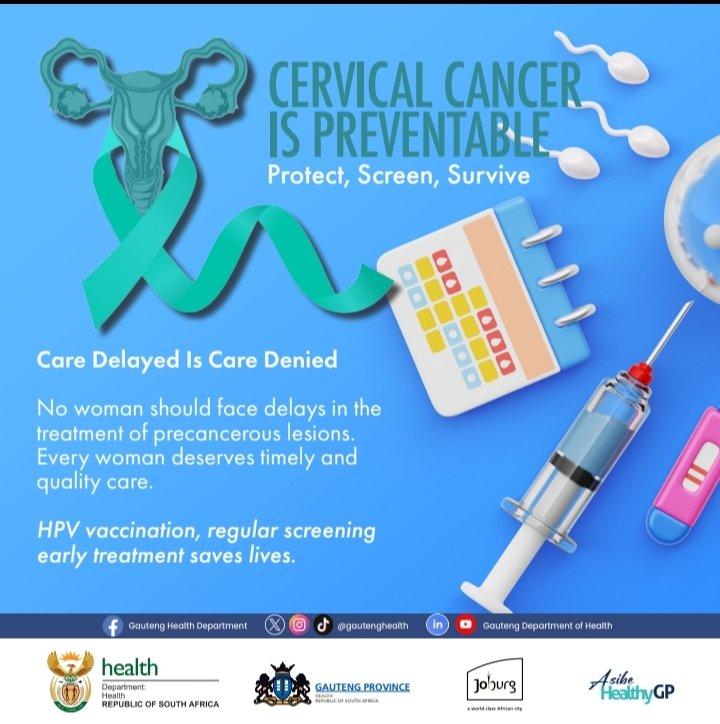
The Department of Health (DoH) has reiterated South Africa’s pledge to eradicate cervical cancer as a public health threat by 2030, aligning efforts with the World Health Organisation (WHO) global strategy.
World Cervical Cancer Elimination Day is commemorated annually on 17 November.
“The Department of Health joins the global community in raising awareness of a disease that remains one of the leading causes of cancer deaths among South African women, despite being largely preventable through vaccination, screening and early treatment.
“In 2024, an estimated 8 382 women were diagnosed with cervical cancer, while approximately one woman died from the disease every 67 minutes. These statistics highlight the urgent need to strengthen prevention, early detection, treatment and follow-up care,” the department said in a statement.
The DoH noted that South Africa’s Cervical Cancer Elimination Strategy 2026 – 2030 provides a coordinated national roadmap to accelerate progress towards WHO’s 90–70–90 targets.
The targets include:
- Vaccinating 90% of girls against human papillomavirus (HPV) by age 15.
- Screening 70% of women with a high-performance test at ages 35 and 45.
- Ensuring that 90% of women diagnosed with cervical disease receive the appropriate treatment.
“HPV vaccination remains the foundation of cervical cancer prevention. Since the introduction of South Africa’s school-based HPV vaccination programme in 2014, millions of girls have received protection against the virus responsible for almost all cases of cervical cancer.
“In line with updated WHO recommendations, South Africa has transitioned from a two-dose to a single-dose schedule, a move expected to improve programme efficiency and expand coverage.
“The department has broadened access to HPV vaccination by including girls aged nine years attending private schools and is strengthening efforts to reach girls missed during previous campaigns. Plans are also underway to extend vaccination services to out-of-school girls,” the statement read.
Earlier this year, government’s school vaccination campaign reached some 428 395 girls in Grades 5 to 7, who received the HPV vaccine, achieving 90.6% campaign coverage, with six provinces exceeding 90%.
“Recognising the increased risk faced by women living with HIV, the department will continue to assess strategies to strengthen cervical cancer prevention and care for higher-risk populations, in line with evolving policy and programme considerations,” the statement explained.
Expanding access
The DoH is also expanding access to HPV DNA testing across all provinces and strengthening treatment services for women diagnosed with precancerous lesions.
“Working with partners, including the Clinton Health Access Initiative [CHAI] and Unitaid, the department is scaling up access to thermal ablation equipment and improving the integration of screening and treatment services to reduce loss to follow-up.
“The department is piloting integrated screening and treatment models at Ceza Hospital in KwaZulu-Natal and Mofolo Community Health Centre in Gauteng to strengthen the continuum of care for women at risk of cervical cancer.
“Between April and September 2026, the number of women screened increased from 869 to 1 086 at Ceza and from 431 to 1 266 at Mofolo, compared with the same period in 2025. These early results demonstrate the potential of strengthened patient pathways, active follow-up and targeted service delivery to improve screening uptake,” the statement noted.
Furthermore, the department is also deploying additional equipment to expand access to treatment for precancerous lesions.
“In September 2026, 201 thermal ablation devices and 24 Large Loop Excision of the Transformation Zone (LLETZ) machines were secured to help increase treatment capacity and bring services closer to communities, particularly in underserved areas.
“Women’s access to timely diagnosis and treatment remains central to the elimination effort. The department continues to invest in oncology infrastructure, strengthen referral pathways and expand treatment capacity to ensure that women diagnosed with cervical cancer receive the care they need,” the statement said.
Health officials are also being empowered through capacity-building initiatives, including a series of webinars since October this year.
Whole of society approach
The department noted that a “substantial” investment is required to eliminate cervical cancer, estimating that the complete package costs stand at R3.1 billion annually, with about 77% spent on treating invasive cancer.
“Its accelerated scenario, designed to achieve the 90-70-90 targets by 2030, models an additional investment of R3.42 billion over the 2027/8 to 2029/30 period.
“Compared with maintaining current coverage, the model projects that approximately 19 500 cervical cancer cases and 15 900 deaths could be averted over 15 years,” the statement highlighted.
Achieving complete elimination will require a “whole-of-society response”.
“Government, civil society, development partners, healthcare professionals, researchers, the private sector and communities all have a critical role to play in expanding access to vaccination, screening and treatment services.
“The department calls on all South Africans to support cervical cancer prevention efforts by encouraging HPV vaccination, promoting regular screening and helping women access timely care.
“Through sustained leadership, strong partnerships and collective action, South Africa can eliminate cervical cancer as a public health problem and save thousands of lives in the years ahead,” the statement concluded. – SAnews.gov.za


