


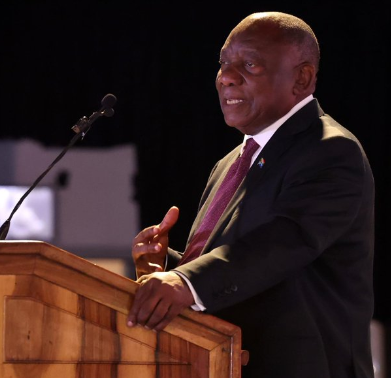
President Cyril Ramaphosa has called for an end to politically motivated appointments, weak accountability and factional battles in municipalities, warning that South Africans can no longer be expected to endure failing services because of dysfunctional local administrations and political instability.
Addressing the launch of the Revised White Paper on Local Government in Ekurhuleni on Thursday, the President said municipalities needed competent administrators, ethical political leadership and effective oversight to restore public confidence in the local government system.
The revised policy proposes sweeping changes to how municipalities are managed, financed and held accountable, with professionalisation, stronger financial controls and improved community participation among its key priorities.
“We need councils that lead with integrity, provide effective oversight and put residents ahead of factional or personal interests.
“We need administrations led and staffed by people appointed for their competence and commitment to public service,” President Ramaphosa said.
The President said the reforms were necessary because too many municipalities were failing to meet the needs and expectations of the communities they were established to serve.
“Too many communities have grown accustomed to services that are unreliable, infrastructure that is deteriorating and municipal administrations that are unresponsive. This cannot continue,” he said.
Political interference and weak accountability
President Ramaphosa acknowledged that some of the problems confronting municipalities could be traced to weaknesses in the original design of the democratic local government system, including insufficient attention to institutional capacity and the risks associated with politicised appointments.
When the democratic government established the new local government system, it sought to integrate communities that had been deliberately divided by apartheid spatial planning and unequal access to resources.
However, the President said government had underestimated the importance of developing a new generation of engineers, town planners and municipal managers to support the system.
“We underestimated how politicised appointments would open the door to corruption, malfeasance and a lack of accountability,” he said.
The revised policy seeks to address these weaknesses by strengthening municipal administrations and clarifying the respective responsibilities of political leaders and professional officials.
President Ramaphosa said political leaders need to respect the lawful responsibilities of administrators, while municipal officials must be held accountable for their performance and conduct.
Public resources must be managed responsibly, procurement processes must be protected from manipulation and officials must face consequences when they neglect their duties.
“There must be consequences when public resources are stolen, procurement is manipulated or public duties are neglected,” he said.
The President emphasised that accountability needs to be applied fairly and consistently, regardless of an individual's political standing or personal connections.
“The exercise of accountability must be fair, lawful and consistent, regardless of status, political affiliation or personal connections,” he said.
The proposed reforms are intended to strengthen the administrative foundations of municipalities, while ensuring that elected representatives fulfil their oversight responsibilities.
Restoring public trust through service delivery
The President said the relationship between municipalities and residents is ultimately shaped by the quality of services people receive in their daily lives.
For many South Africans, the performance of government is measured by whether water flows from their taps, streetlights work, roads are safe and refuse is collected.
When municipalities fail to provide these services, the President said the consequences extend beyond inconvenience.
“When these services work, people experience the promise of democracy. When they fail, it is not merely an inconvenience. It affects people's health, their livelihoods, their safety and their dignity,” the President said.
He said persistent service delivery failures also undermine confidence in government and weakened public faith in democratic institutions.
The revised policy, therefore, seeks to make municipal administrations more responsive to residents and ensure that complaints result in action.
“Participation cannot be reduced to meetings where people speak but nothing changes. Trust will not be restored by speeches.
“It will be restored when a reported fault is fixed promptly; when a resident receives an honest response to a complaint, and when municipal leaders account openly for their decisions,” he said.
The President said communities need to be active partners in governance, with access to information about municipal commitments, available resources and progress in delivering services.
This would require municipal leaders to account openly for their decisions and demonstrate that public participation can influence the way municipalities operate.
Municipal finances must serve communities
The President also raised concerns about the financial position of municipalities, saying unsustainable finances and poor infrastructure maintenance are undermining their ability to deliver essential services.
Municipalities owe Eskom more than R120 billion, while many are also in arrears to water boards.
The revised policy proposes stronger financial management, improved revenue collection, reduced losses and spending that delivers value to communities.
The President said municipalities need to use revenue from essential services responsibly, particularly as ageing infrastructure continues to deteriorate.
“Revenues from the sale of electricity and water will be ring-fenced and used to maintain infrastructure before anything else,” he said.
The proposed measure is intended to ensure that money generated through water and electricity services is prioritised for maintaining the infrastructure required to sustain those services.
The President warned that municipalities cannot continue neglecting existing infrastructure while investing in new projects.
“We cannot build our way out of failure if we do not maintain what we have already built,” he said.
He also said residents who can afford to pay for municipal services should contribute, but municipalities have a responsibility to demonstrate that public money is being used properly.
“Government, in turn, must earn that contribution through reliable services, transparent decisions and responsible stewardship of public funds.”
The approach seeks to strengthen the link between financial accountability and service delivery, ensuring that municipal resources are directed towards the needs of communities.
Municipalities must work together
President Ramaphosa said municipal dysfunction cannot be addressed by focusing exclusively on individual municipalities, as their performance is also influenced by the laws governing them, the responsibilities assigned to them and the support they receive from other spheres of government.
He called for stronger coordination between national government, provincial administrations, municipalities and State-owned entities to ensure that investment and service delivery priorities are aligned.
The Revised White Paper proposes a differentiated approach to municipal powers and functions, recognising that municipalities have different levels of institutional capacity, financial resources and ability to deliver services.
Under the proposed model, responsibilities would be aligned with municipal capability, with some functions potentially delivered at regional level or assigned elsewhere where a municipality could not perform them effectively.
The policy also proposes stronger regulation of water and electricity services, including compulsory licensing for providers and a separation between the authority responsible for a service and the entity providing it.
The President said the reforms would combine greater support for municipalities with stronger regulation and intervention, where necessary.
National and provincial government, he said, cannot stand apart from municipal failures when problems are rooted in the wider system.
Implementation must go beyond policy
The launch of the Revised White Paper marks a shift towards implementing reforms intended to address the structural weaknesses of local government.
Cabinet has endorsed a phased implementation approach supported by a time-bound Local Government Transition Management Body, with coordinated leadership from the Department of Cooperative Governance and Traditional Affairs, The Presidency and National Treasury.
A single Local Government Transition Plan will identify the changes required, the institutions responsible for implementing them, the sequence of actions and how progress will be measured.
The transition management body will coordinate the reform process without taking over the lawful responsibilities of Ministers, provinces, municipal councils and administrations.
Some proposals will require legislative changes, new financing arrangements, additional institutional capabilities and potentially constitutional amendments.
The President said the reforms will require consultation and disciplined implementation, but that government needs to begin the work without delay.
The revised policy follows a review of nearly three decades of democratic local government, established through the 1998 White Paper to address the fragmented and unequal municipal system inherited from apartheid.
While government has made significant progress in expanding access to basic services, President Ramaphosa said persistent infrastructure problems, financial distress and institutional weaknesses demonstrate the need for a new approach.
Elections must not come at the expense of services
The President's call for greater accountability comes less than two weeks before the Local Government Elections scheduled for 4 November.
He urged registered voters to participate in the elections, while reminding political parties and candidates that their responsibility to communities must take precedence over political competition once they assume office.
The President said local government reform needs to extend beyond electoral cycles, municipal terms and individual administrations.
He thanked Cooperative Governance and Traditional Affairs Minister Velenkosini Hlabisa and the institutions, researchers, practitioners and citizens who contributed to the policy review.
President Ramaphosa said the priority now is to translate the revised policy into practical changes that will improve municipal performance and strengthen public confidence in government.
“A capable State must deliver where people live, work and raise their children. A developmental State must improve their quality of life. A democratic State must earn and keep the trust of its people,” he said.
He called on government and its partners to unite behind the implementation of the reforms.
“We must implement the reforms that are needed to fix local government, even when they are difficult. Let us build municipalities that work for every South African,” he said. – SAnews.gov.za


