


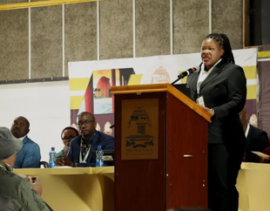
Deputy Minister in the Presidency Nonceba Mhlauli says the courage displayed by the June 16 generation, 50 years ago, transformed the country forever.
“Many of those young people were not much older than the participants gathered in this hall today. They did not possess wealth, political office or institutional power,” Mhlauli said.
Addressing the Mpumalanga Provincial Youth Parliament in Mpumalanga, Mhlauli said those young people understood a truth that continues to resonate across generations, that young people have the capacity to shape history when they organise, participate and refuse to be silent in the face of injustice.
“The true legacy of the youth of 1976 lies not only in what they protested against, but in what they stood for,” Mhlauli said.
Mhlauli said the 1976 youth stood for dignity. They stood for equality. They stood for access to education. They stood for opportunity. They stood for the belief that young people should have a voice in determining the future of their country.
“Today, the responsibility of our generation is different, but it is no less important. The youth of 1976 fought for freedom.
“The youth of 2026 must use that freedom to build prosperous communities, strengthen democratic institutions, hold leaders accountable and create opportunities for future generations.
“They fought to secure a democratic South Africa. We must now ensure that our democracy delivers on its promise for a better life for all,” the Deputy Minister said.
The Deputy Minister told the young people that the Youth Parliament exists because democracy cannot be reduced to voting every five years.
“A healthy democracy requires continuous engagement between citizens and the institutions that serve them. It requires citizens who ask questions. It requires leaders who provide answers. It requires transparency, accountability and active participation.
“The concept behind this Youth Parliament recognises that young people continue to face serious challenges, including unemployment, poverty, economic exclusion, unequal access to opportunities and social vulnerability,” she said.
Mhlauli said the Youth Parliament recognises that young people are not merely beneficiaries of government programmes.
“They are partners in development. They are stakeholders in governance. They are active participants in shaping public policy and monitoring implementation.
“For many years, Youth Parliament has provided an important platform through which young people have influenced public discourse and contributed to policy development,” Mhlauli said.
Mhlauli said the impact of youth activism and youth engagement can be seen in numerous initiatives that have transformed opportunities for young South Africans.
“We have seen the establishment of institutions dedicated to youth development, including the National Youth Development Agency, Youth Directorates at Provincial and Municipal level, and other interventions aimed at expanding opportunities for young people.
“These achievements remind us that youth voices matter and that organised youth participation can influence the direction of public policy,” she said.
With regard to the coming Local Government elections, Mhlauli appealed the young people to register to vote, ensure that their names appears on the voters' roll.
“Verify your details. Make use of the online platforms that have been created to make registration easier and more accessible.
“However, registration alone is not enough. Registration is only the first step. Once you have registered, you must also vote. A democracy cannot be strengthened by people who are registered but absent on Election Day.
“The true power of citizenship lies not only in having the right to vote, but in exercising that right,” Mhlauli said.
Mhlauli told the young people to confront the reality that there are many young South Africans who are uncertain about whether participate in elections still makes a difference.
“Many feel frustrated by the pace of change in their communities. Others question whether their vote has any real impact on the challenges they face every day.
“Some have become disillusioned by instances of poor service delivery, unemployment, inequality and unfulfilled promises. These feelings are real and they should not be dismissed. If we are serious about strengthening our democracy, we must acknowledge these frustrations honestly and engage with them directly,” she said.
Mhlauli said the greatest mistake that young people can make is to conclude that because change has been slower than expected, participation no longer matters.
“The truth is that democracy does not stop functioning when citizens choose not to participate. Decisions continue to be made. Budgets continue to be approved. Development priorities continue to be determined.
“Councillors continue to be elected. Municipal projects continue to move forward. The only difference is that those decisions are made without the input of the very people who are most affected by them,” the Deputy Minister said.
Government recently launched the national programme commemorating the 50th anniversary of the Soweto Uprising.
The launch marked the start of a year-long government programme aimed at honouring the sacrifices of the 1976 student uprising, a defining moment in South Africa’s liberation struggle, while inspiring a new generation of young people. – SAnews.gov.za


